What DNS means
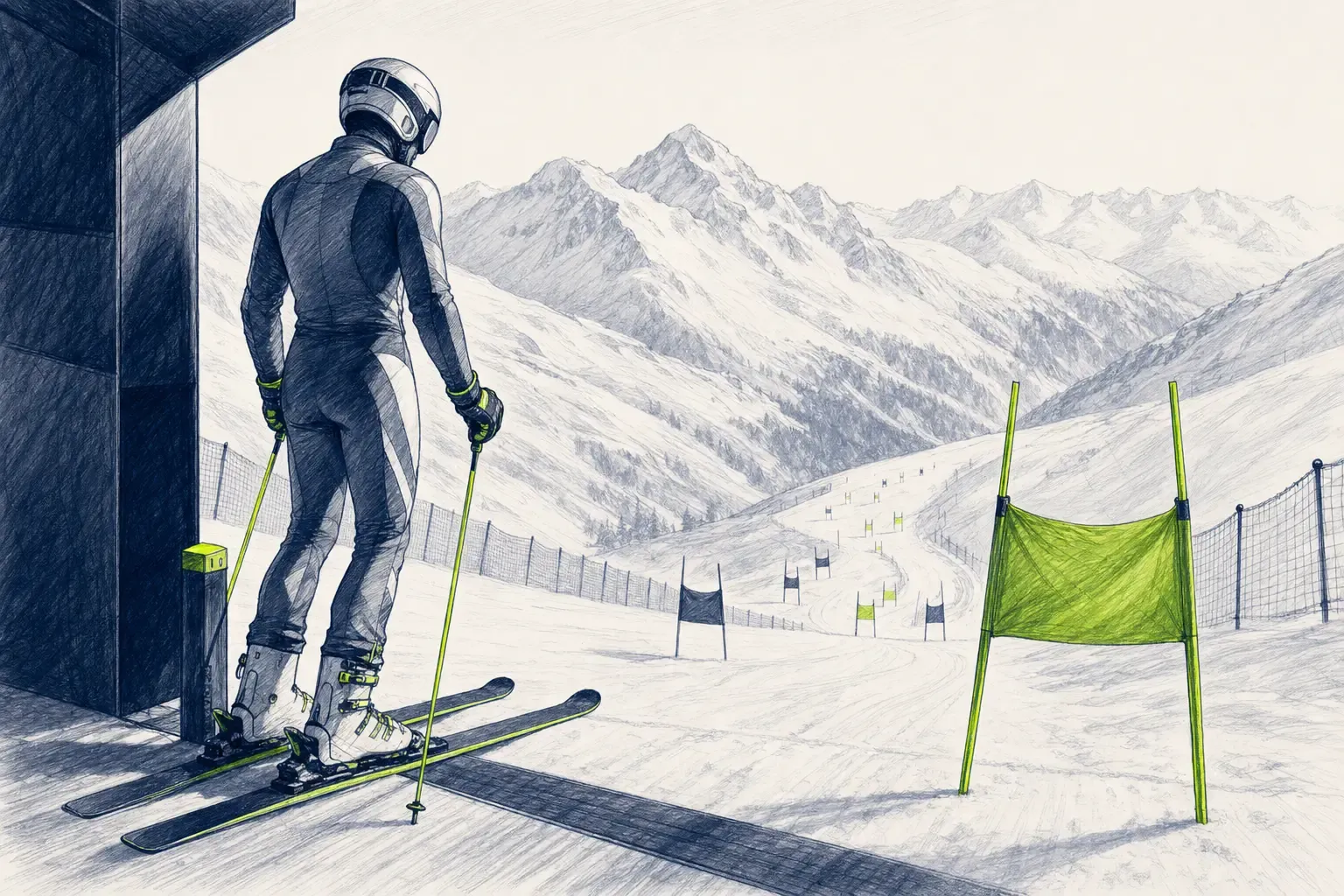
DNS is the international abbreviation from English Did Not Start, meaning “did not start.” In the results, it marks a racer who did not begin that run.
In the FIS data standard, you may also come across the labels DNS1, DNS2 or DNS3. The number indicates Run 1, Run 2 or Run 3. In this text, for two-run slalom and giant slalom, we use the names first and second run: DNS1 indicates not starting in the first run and DNS2 in the second run. DNS3 refers to the third run, if the competition format includes one. The code itself does not express why the racer did not start or whether they met the conditions to advance to the next run.
The official FIS results list should separately note racers who were not at the start, did not finish the run, or were disqualified. DNS is therefore not a placing or a recorded time.
DNS, DNF, DSQ and NPS are not the same
These abbreviations describe different situations:
- DNS – Did Not Start: the racer did not begin the run.
- DNF – Did Not Finish: the racer started but did not finish the run.
- DSQ – Disqualified: the racer was disqualified.
- NPS – Not Permitted to Start: the racer was not allowed to start because they did not meet one of the rules' conditions.
A delayed or false start should therefore not be recorded automatically as DNS. The FIS rules for these situations set out a separate procedure, and depending on the circumstances a penalty or disqualification may follow.
The start referee informs the referee of the names of the racers who did not start. In particular, they inform the jury about rule violations, such as a false or delayed start or a violation of equipment rules. Reporting DNS to the referee and informing the jury about a rule violation are therefore not the same duty.
DNS in two-run races
If a racer is entered under the rules into the second run of slalom or giant slalom but does not start, the result list shows them as DNS2. Without a time from the second run, they cannot be classified in the final ranking of two-run races.
According to the FIS rules, after a DNS status in the first run, a racer usually does not continue to the next run. FIS alpine combined races have a precisely defined exception: a racer with DSQ, DNS, NPS or DNF status in the slalom part may start in the speed part. If the speed part comes before the slalom, this exception does not apply.
In Slovak children's and national races, you should follow the ZSL competition rules valid for the given season, the event regulations, and other applicable rules. However, as of 2 September 2026, the official ZSL website did not publish the competition rules 2026/2027 for alpine skiing on snow; in section 2026/2027, only the rules for alpine disciplines in grass skiing were available. Therefore, no rules for the following season can be inferred from the rules for season 2025/2026. After the current rules are published, the national procedure must be checked directly according to them.
The jury may decide only within the scope of the powers given to it by the applicable rules. If specific rules allow an additional run outside the regular classification, this is a special race provision, not the general meaning of the DNS abbreviation.
A coach's and parent's practical view
DNS alone does not explain why the racer did not start. It may follow withdrawal due to health issues, an injury, or a decision that starting would not be safe. With a child, it makes no sense to push them to start just to avoid the DNS abbreviation. If they feel pain, are unusually tired, or do not feel right after a fall, their condition and safety come first.
If a fall or blow to the head or body raises suspicion of a concussion, the child must be removed from sports activity immediately. They should not return to the course that day, and any later return should be assessed by a doctor or another qualified healthcare professional. Neither coach nor parent should judge the severity of a possible concussion themselves.
From a practical organizational point of view, it is appropriate to notify the organizer or the start referee of the absence as soon as possible; however, this is not a general duty of the coach formulated in this way in the ICR. The formal procedure is always determined by the competition rules and the organization of the particular race.
In the case of a late arrival, the FIS rules state that a minor indisposition or a defect in personal equipment do not in themselves constitute force majeure. However, this is a rule for assessing a delayed start, not a reason to force a child to start despite health or safety concerns.
DNS is not a disgrace or an assessment of skiing technique. It is a precise administrative record that the racer did not start the run in question.
Sources and further reading
- FIS – International Competition Rules for Alpine Skiing, edition July 2026
- FIS – Alpine Data Booklet, PDF internally marked as version 1.15 dated 31. October 2025; the FIS library lists it as version 1.16
- FIS – Timing & Data, the official library of data and timing documents
- FIS – official results list with sections Did not start 1st run and Did not start 2nd run
- Slovak Ski Association – sports and technical regulations and forms, status checked 2. September 2026
- CDC HEADS UP – procedure for suspected concussion in sport