What motor learning is
Motor learning (motor learning) refers to processes linked to practice or experience that lead to a relatively lasting change in the ability to perform a movement skill. So it is not just one successful turn on a single run. Learning shows when the skier can repeat the solution later, use it without constant guidance, and adapt it to different terrain, speed, or rhythm.
Motor learning must be distinguished from immediate performance. A child may improve quickly during training thanks to precise instructions, a demonstration, or the coach’s guidance, but after a break the improvement may not last. On the other hand, training that involves searching for a solution may for a while look less polished, but it can lead to better retention and transfer of the skill.
Motor development is also related to learning, but it is not the same thing. Development includes changes connected with growth and maturation. Learning arises through experience. In practice, the two processes overlap: children of the same calendar age may differ in coordination, attention, strength, prior experience, and the ability to understand instructions.
How learning shows on skis
A skier does not acquire an isolated body position, but the relationship between their own movement, the skis, and the environment. They must perceive the slope and its irregularities, the quality of the snow, speed, direction of travel, and the equipment’s response. At the same time, they time loading, unloading, edging, and guiding the skis according to the situation that develops.
Practical signs of learning can include:
- retaining the skill after a break or at the next training session,
- transfer to a different turn radius, terrain, or gate course,
- less dependence on the coach’s instructions,
- the ability to recognize one’s own mistake and suggest a correction,
- a suitably stable solution even in changing conditions.
One successful run is therefore not enough to conclude that a child has mastered the movement. The coach watches for repeatability, independence, and adaptability over time.
Instructions, attention, and feedback
Research often distinguishes internal focus of attention, for example, knee position, and external focus, in which the skier focuses on the effect of the movement or the target in the environment. External focus can support more automatic movement control, but research results in children are not consistent across all tasks and groups. The instruction should therefore be adapted to the age, experience, specific task, and what the child understands.
In ski practice, a short goal is often more useful, such as “glide quietly over the bump” or “keep your line in the corridor,” than a long list of body-part positions. Especially younger children benefit from a demonstration, an image-based comparison, a marked track, and a simple movement task. Explicit technical explanation has its place, but it should not overshadow the actual skiing and awareness of the slope. When choosing between conscious and more implicit learning, experts emphasize the athlete’s abilities, the nature of the task, and the learning stage.
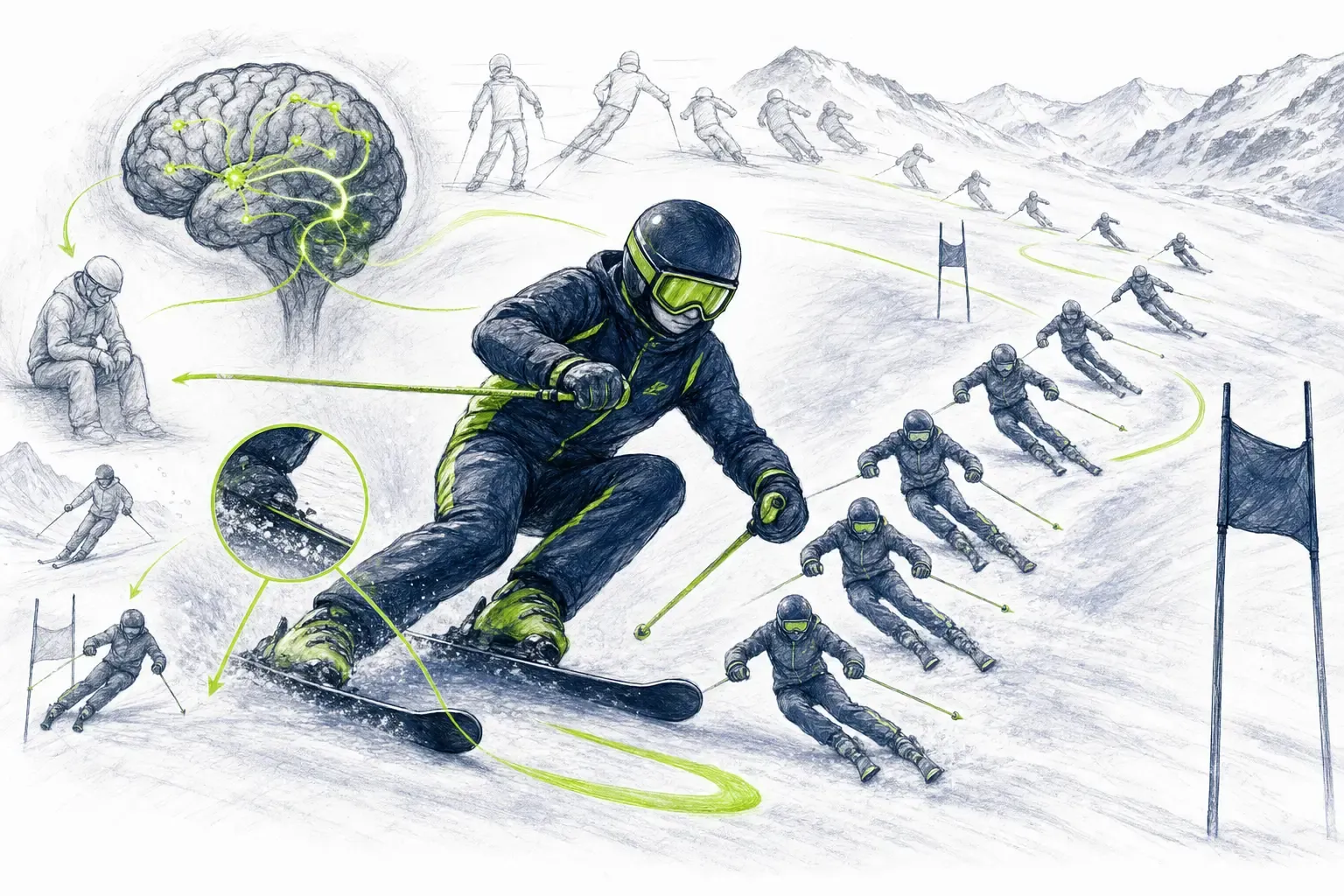
Feedback should be specific and tied to the attempt or result, not to a supposed trait of the child. The sentence “in this turn you started changing direction too late” provides usable information. The label “you are not a technical type” judges the person and does not help learning. Research with children highlights especially the unsuitability of negative feedback phrased as a general judgment about abilities.
There is no universal rule that the coach must correct every attempt or, conversely, say as little as possible. For a new and safety-sensitive task, a child may need more frequent guidance. Later, it is appropriate to give them time to evaluate for themselves, ask what they felt or saw, and gradually reduce feedback. Systematic reviews show that the effect of feedback frequency, form, and timing depends on the task and the athlete; with children, no single approach can be called the best in all situations.
Repetition and variability
Without enough attempts, the skill will not take hold. But simply repeating the same exercise mechanically does not guarantee that the solution will transfer to real skiing. Research on exercise variability, especially with children, brings mixed results and does not support the simple rule “the more varied, the better.”
Training practice is to start in conditions the child can handle safely, and then appropriately change the radius, rhythm, slope, speed, line, or terrain character. The difficulty is not increased in all elements at once. The goal is not to create random chaos, but to teach the skier to adjust movement according to the key information.
The American system for developing alpine skiers emphasizes a broad foundation of agility, balance, and coordination in the children’s stages, multiple movement activities, and a gradual transition from exploring terrain to more precise execution of skills. It is a framework for long-term development, not a binding training prescription for every child.
Race context
In racing, motor learning is tested by the ability to transfer technique to a changing course. Gates do not only determine where to pass; they create a problem of timing, direction, speed, and line choice. A skier who can handle an exercise only in one rhythm or only after constant instruction may still not know how to use the solution independently.
That is why the coach does not judge only how the skiing looks. The coach watches whether the chosen task changes the needed behavior, whether the athlete understands its goal, and whether improvement appears even without help. A short technical exercise makes sense when its effect is then connected with the full run.
Typical misunderstandings
- A mistake is not always proof of poor learning. When searching for a solution, failed attempts also happen. But the coach should not leave a dangerous or repeated mistake unaddressed.
- Perfect imitation is not the only goal. Children differ in body proportions, experience, and equipment; what matters is the function of the movement.
- More instructions do not mean more learning. Too much information can distract from the essential task.
- Play is not the opposite of training. A suitably chosen game can create lots of repetition, decision-making, and natural variability.
- Quick improvement during a single run may not be lasting. Learning must be checked again after some time and in a changed situation.
From a coach’s perspective, motor learning means managing the conditions in which the child independently discovers and gradually stabilizes functional movement solutions. Good guidance combines safe organization, a clear goal, enough runs, appropriate feedback, and space for independent perception and decision-making.
Sources and further reading
- 1. How can instructions and feedback with external focus be shaped to enhance motor learning in children? A systematic review
- 2. Frequent External-Focus Feedback Enhances Motor Learning
- 3. Multidisciplinary Views on Applying Explicit and Implicit Motor Learning in Practice: An International Survey
- 4. Effects of Generic versus Non-Generic Feedback on Motor Learning in Children
- 5. Effects of Feedback on Students’ Motor Skill Learning in Physical Education: A Systematic Review
- 6. Variability of Practice, Information Processing, and Decision Making—How Much Do We Know?
- 7. U.S. Ski & Snowboard – Alpine Training Systems