What is the base?
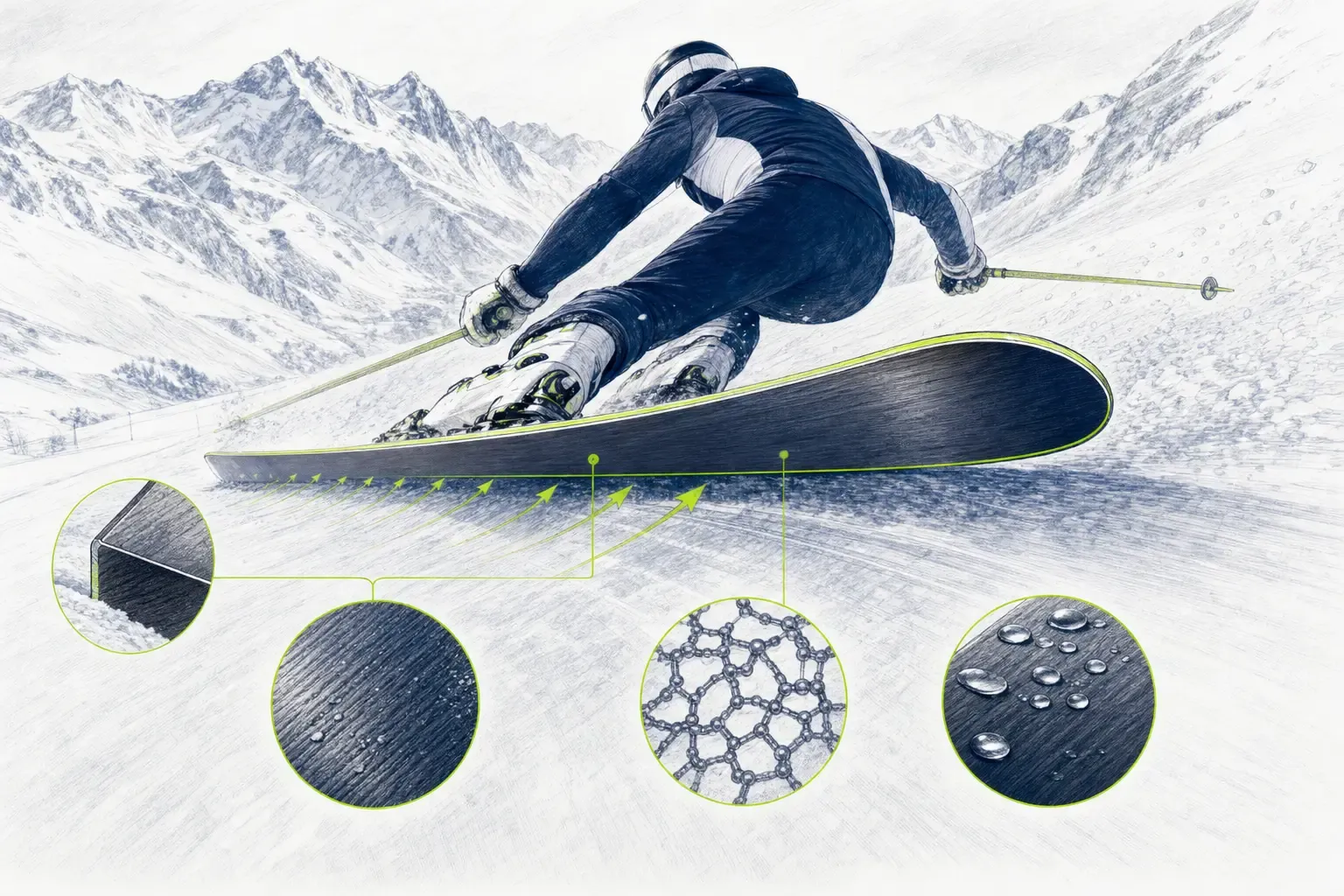
Base is the bottom surface of the ski, bordered by steel edges. On modern alpine skis, it is made of durable polyethylene gliding material. Its role is to create functional contact with the snow, allow smooth gliding, and carry the structure and glide wax.
Do not confuse the base with the edge. The edges provide support and steer the ski on hard snow, while the condition of the base strongly affects gliding, ride smoothness, and how the ski behaves when moving between different snow types.
What affects glide quality
Four properties are especially important:
- Flatness: the base and edges should form a properly prepared functional unit. A concave or overground ski can be unpredictable and may not be set correctly by edge grinding alone.
- Structure: fine grooves created by professional grinding affect contact with the snow and the removal of water from under the ski. The right structure depends on temperature, humidity, snow grain size, and discipline. There is no single fastest structure for all conditions.
- Waxing: glide wax adjusts the surface properties of the base and helps achieve a more even glide. However, waxing does not replace repair of an uneven, burnt, or deeply damaged base.
- Cleanliness and damage: dirt, residue from unsuitable products, grooves, and torn-out material can worsen glide. The seriousness of a groove is judged not only by its length, but especially by its depth and position near the edge.
Fine surface scratches are normal in regular children's skiing and usually do not require immediate filling. A deep groove reaching the ski construction, damage at the edge, separation of layers, or significant deformation belong in professional service.
Children's ski base
A beginner mainly needs a ski that behaves consistently. Large differences in glide between the left and right ski, catching on a damaged base, or wet snow sticking to the ski can disturb balance and make it harder to learn basic movements.
For children's skis, a sensible routine is enough: after skiing, remove snow and water, let the skis dry, regularly check the base, and use a suitable fluorine-free wax according to the manufacturer's instructions. Service frequency depends on the number of days on snow, the quality of the slope surface, and how the skis are used. There is no universal interval for all children and skis.
The waxing iron must be used at the temperature specified by the wax manufacturer. Too high a temperature or leaving the iron too long in one place can damage the base. Ventilation, a stable work area, and adult supervision are necessary when working; deep repairs and machine grinding belong to service.
Race context
In racing skiing, the structure, hardness of the wax, brushing method, and final finish are chosen according to the discipline and the current snow conditions. Speed events, giant slalom, and slalom do not have to use the same preparation. The result should be judged by a test on snow, not only by the look of the base.
FIS rule: the use of fluorinated waxes or tuning products containing fluorine is prohibited in all disciplines and at all FIS levels. Using such a product in competition can lead to disqualification. Older waxes of unclear composition therefore do not belong in race preparation.
Typical misconceptions
A grayish surface does not automatically mean that the ski only needs more wax. It may also be mechanical wear, residues from preparation, or heat damage. Nor is it true that frequent aggressive grinding always improves glide: every machine intervention removes material and should have a specific reason.
From a coach’s point of view, the base should mainly be flat, safely repaired, and suited to the conditions. For young skiers, quality basic preparation supports learning, but it does not replace technique, balance, or an appropriately chosen ski.
Sources and further reading
- FIS – Specifications for Alpine Competition Equipment 2026/27
- FIS – Fluor Documents
- FIS – Fluor Ban Implementation in Alpine Skiing
- FIS – Decisions of the FIS Council, full fluor-wax ban
- FIS – Update from the 2023 Alpine Committee meetings
- FIS – FIS widens scope of fluor testing
- Swix – Guide to base structuring and rilling tools