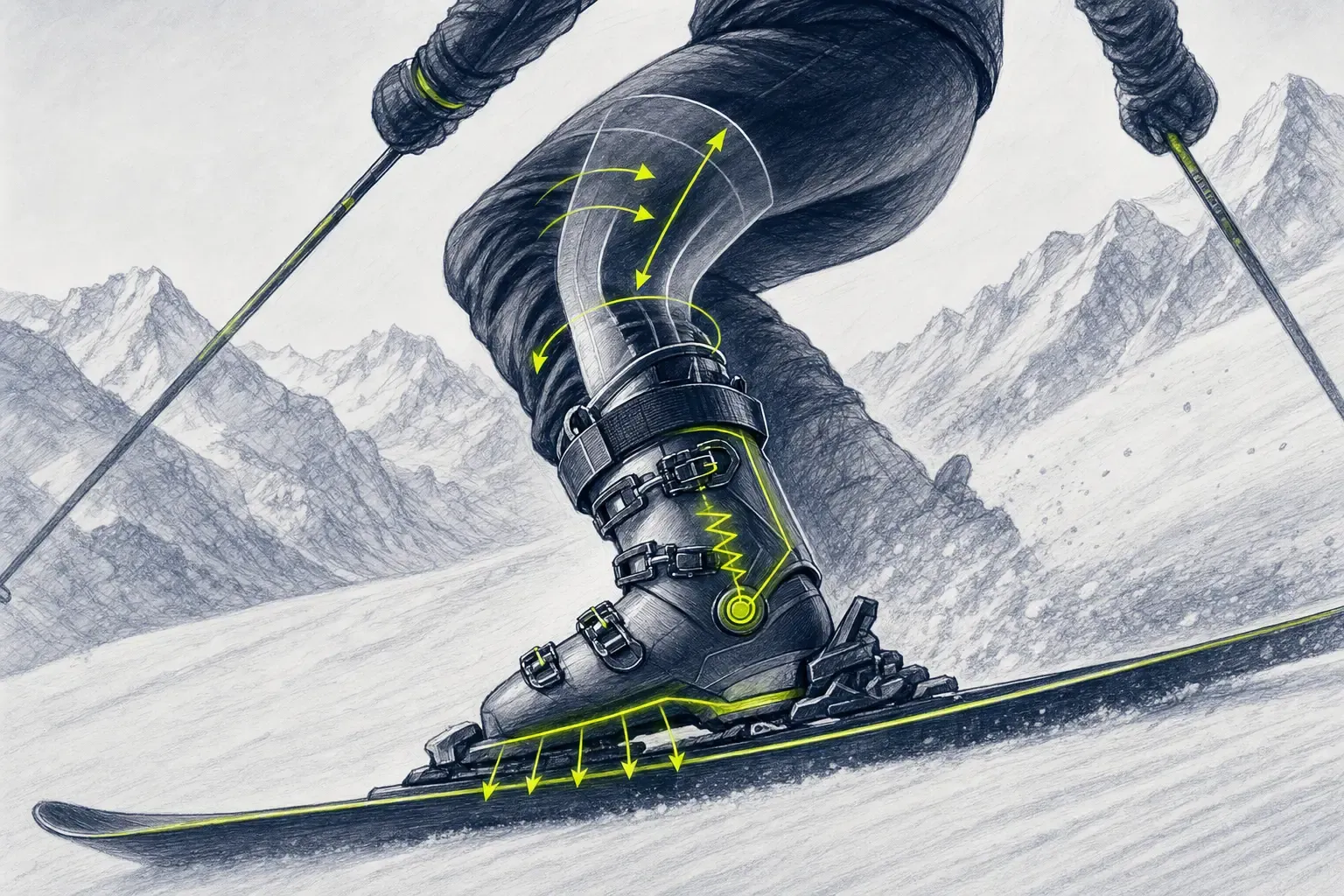
Boot flex is the resistance the shell and cuff of the ski boot offer when the lower leg moves forward. The manufacturer usually marks it with a number called flex index. A higher number usually means a stiffer boot, a lower number a softer one.
Flex affects how easily a skier can bring the lower leg into contact with the tongue of the boot, how the ankle can move, and how forces are transferred between the body, the boot, and the ski. However, it is not the only factor that determines whether a boot is suitable. Equally important are the shell size and shape, heel hold, cuff height and shape, the liner, and the overall stance setup.
What the flex number really means
Verified fact: flex index is not a single physical unit or a generally standardized scale. The value 90, 110 or 130 cannot be automatically compared across different manufacturers, constructions, and product lines. Research comparing nominal flex with stiffness measured on skiers found only a moderately strong relationship and significant differences between the label and the boot’s actual behavior.
Flex is therefore not similar to binding release force settings. It is not a DIN value, a safety setting, or a measure of how many degrees the boot bends.
Two boots with the same index can feel different. Not only the overall resistance may differ, but also its curve: one boot starts bending more easily and then becomes much stiffer, while another offers more even resistance. Mechanical response is affected by construction, buckle closure, the foot’s contact with the shell, temperature, and movement speed. Measurements have shown that at higher bending speeds, both stiffness and the amount of energy absorbed by the material can increase. A feeling from slow testing in a heated shop therefore may not accurately match behavior on the slope.
The practical importance of the right flex
A suitable flex lets the skier move the lower leg forward in a controlled way, while the cuff provides support and rebounds. The skier can then regulate pressure and maintain a balanced stance without unnecessary fighting against the boot.
Training practice: a boot that is too stiff often shows up in a child as limited ankle movement, difficulty bringing the lower leg to the tongue, and compensation through the knees or hips. The child may look rigid or stay back. An older ski-learning study recorded less forward flexion and poorer acquisition of movement with stiffer boots in the skiers it followed. This does not mean, however, that every technical mistake is caused by the wrong flex.
A boot that is too soft may bend under load without enough support. At higher speed, greater weight, or a more aggressive ski stance, the skier then has a harder time maintaining stable contact with the cuff. Evaluation must always be done together with checking the shell size and shape: a boot that is too large or poorly buckled may feel soft and imprecise even if its nominal flex is high.
Children’s boot flex
For children, suitable flex cannot be determined by age alone. The main factors are:
- body weight and height,
- strength and motor development,
- range of motion in the ankles,
- skiing level and riding speed,
- discipline and how it is used,
- fit accuracy and shape adaptation of the ski boot.
A beginner needs a level of resistance that they can overcome repeatedly and without forcing it. A young racer may need more support under higher forces, but the claim that "the higher the flex, the better the racer" is wrong. If a child cannot actively bend the cuff, a high number by itself will not give more precise ski control.
Flex should not be increased just to compensate for an oversized shell bought "for growing into." Size and stiffness are two different parameters. Likewise, a recommendation from a junior model cannot simply be transferred to an adult model with the same number without trying it on.
Racing context and the coach's view
In racing skiing, flex is chosen according to the forces the skier creates, the required precision, and the ability to maintain an active stance throughout the run. A stiffer racing boot can provide more pronounced support, but only if the skier can load it dynamically. What matters is how it behaves on snow, not simply pushing into the tongue while standing still.
The coach mainly watches whether the skier:
- can work smoothly in the ankles,
- stays balanced without falling back,
- maintains stable contact with the tongue and cuff through the turn,
- can absorb bumps and changes in pressure,
- does not change technique just to overcome the boot's resistance.
Flex should not be confused with forward cuff lean, lateral cuff adjustment, or the spoiler position. These elements can change stance and the feel of the boot, but they do not represent the same property.
Some models allow stiffness adjustments specified by the manufacturer using screws or other design elements. Removing screws, cutting, or grinding the shell without the manufacturer's instructions can change its function. Such modifications belong to a qualified bootfitter or service technician who knows the specific model and the skier's needs.
Sources and further reading
- Salomon – What is ski boot flex?
- Immler, Schindelwig, Heinrich, Nachbauer – Individual flexion stiffness of ski boots, Journal of Science and Medicine in Sport
- Hasler et al. – On the measurement of ski boot viscoelasticity, Journal of Science and Medicine in Sport
- Petrone, Marcolin, Panizzolo – The effect of boot stiffness on field and laboratory flexural behavior of alpine ski boots, University of Western Australia
- Knye et al. – Flexural Behavior of Ski Boots Under Realistic Loads: The Concept of an Improved Test Method, Procedia Engineering
- Ski boots versus the knee joint. 2: What produces the forward leaning position of the ski boot? – PubMed
- Testing and Experimental Research on the Flexural Stiffness of Alpine Ski Boots Based on Buckling Mechanical Characteristics, Applied Sciences