What a binding riser plate is
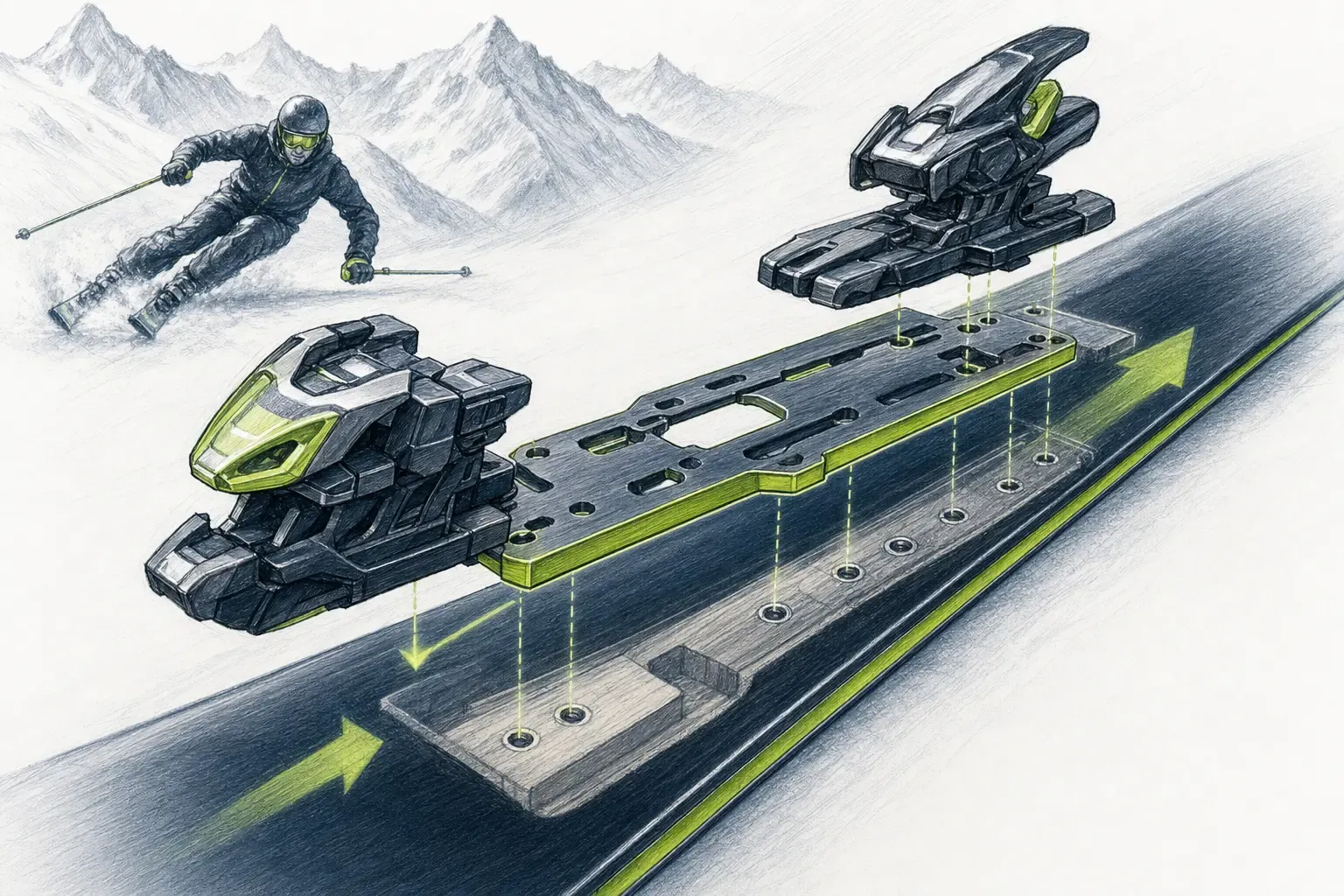
Binding riser plate is a structural part placed between the ski and the toe and heel pieces of the binding. The terms mounting plate, system rail, race plate, or race plate. The plate may be permanently integrated into the ski at the factory, or it may be mounted as a separate part.
Not every ski needs one. On a so-called flat ski, a compatible binding can be mounted directly onto the ski. On system skis, the binding slides onto or attaches to a manufacturer-specific rail. Race skis often use a special plate with precisely defined mounting holes.
What it does
The exact properties always depend on the plate design. It can perform several tasks at once:
- create a compatible mounting interface between the ski and the binding,
- allow the binding to be adjusted to the boot shell length without repeated drilling, if the system supports it,
- distribute forces from the binding over a larger part of the ski,
- affect the stiffness and flex of the ski under the boot,
- raise the boot position above the snow,
- partly influence damping and the feel of power transmission, depending on the material and construction.
A plate does not have to stiffen the ski only. Some systems are designed so that the toe and heel of the binding can move in a controlled way relative to each other as the ski bends. Another, stiff race plate can, on the other hand, noticeably change how the middle section of the ski behaves. Therefore, the properties of one plate cannot automatically be attributed to all the others.
A higher stance increases the distance between the edge and the boot. It can make it easier to achieve a larger edge angle before the boot or binding touches the snow. But a greater height alone does not guarantee better turning or faster skiing. It changes leverage, the setup’s response, and the skier’s balance demands.
Children and racing
On children’s recreational skis, light system rails and bindings with a range matching a child’s boot are usually used. The advantage can be easier adaptation to a different shell length. A heavy or very stiff race plate may not be suitable for a small and light child, because it can increase the weight of the setup and change the ski’s natural flex.
Training practice: the choice of plate should match the ski, binding, weight, technical level, and racing program of the child. For a beginner, the more important factors are appropriate ski length and stiffness, correctly adjusted bindings, and mastering the basic movements rather than choosing the tallest or stiffest plate possible.
Competition rule: FIS limits the total height of the ski – riser plate – binding setup. In the current specifications for alpine competitions 2026/2027, the maximum distance between the ski base and the sole of the ski boot 50 mm. For national and children’s competitions, always check the rules of the relevant federation and the specific age category as well.
Compatibility and safe mounting
The riser plate, binding, and ski are not freely interchangeable parts. What matters are the mounting holes, the recommended binding type, screw length, mounting point position, and the manufacturer’s instructions. A binding designed for one system track cannot be used automatically on another plate, even if the parts look similar at first glance.
Mounting, retrofitting, or replacing the riser plate should be done by a qualified service center according to the manufacturer’s technical documentation. Incorrect screws may be too short, damage the ski structure, or penetrate through to the base. After mounting, the service center must also check the adjustment and function of the entire ski – binding – boot system.
The riser plate itself does not determine the binding release force and does not replace its correct adjustment. It should not be confused with the sliding pad under the boot toe, which is a functional part of a specific binding.
Common misconceptions
- The higher the riser plate, the better the ski: height changes geometry and leverage, but suitability depends on the skier and the discipline.
- Every race plate fits every binding: compatibility must be confirmed by the manufacturer or in its technical documentation.
- Moving the binding on the track is only about boot size: changing the position can also affect the feel of turning and the ski’s load distribution.
- The riser plate can be used to freely adjust leg alignment: corrections of canting and axial alignment are a separate technical topic and should not be addressed with unverified inserts under the binding.
From a coach’s point of view, it is important to assess the whole setup. A suitable riser plate supports the function of the ski and binding; an unsuitable one can add weight for the child, change the ski’s response, or create an incompatible and potentially dangerous setup.
Sources and further reading
- FIS – Specifications for Alpine Competition Equipment 2026/2027, document page
- FIS – Specifications for Alpine Competition Equipment 2025/2026, October edition 2025
- FIS – Specifications for Alpine Competition Equipment 2025/2026, June edition 2025
- HEAD/TYROLIA – Rental Systems Technical Manual 2023/2024
- HEAD/TYROLIA – Rental Solutions Handbook and requirements for professional service
- TYROLIA – technical catalog of binding systems, plates and the Free Flex principle