What is a ski binding
Binding is a mechanical system that attaches the ski boot to the ski, transfers the skier’s movements and forces, and can release the boot under a specified load. This entry concerns mainly downhill, that is, alpine safety bindings. Ski touring bindings have a different design, and a separate ISO 13992 standard applies to them.
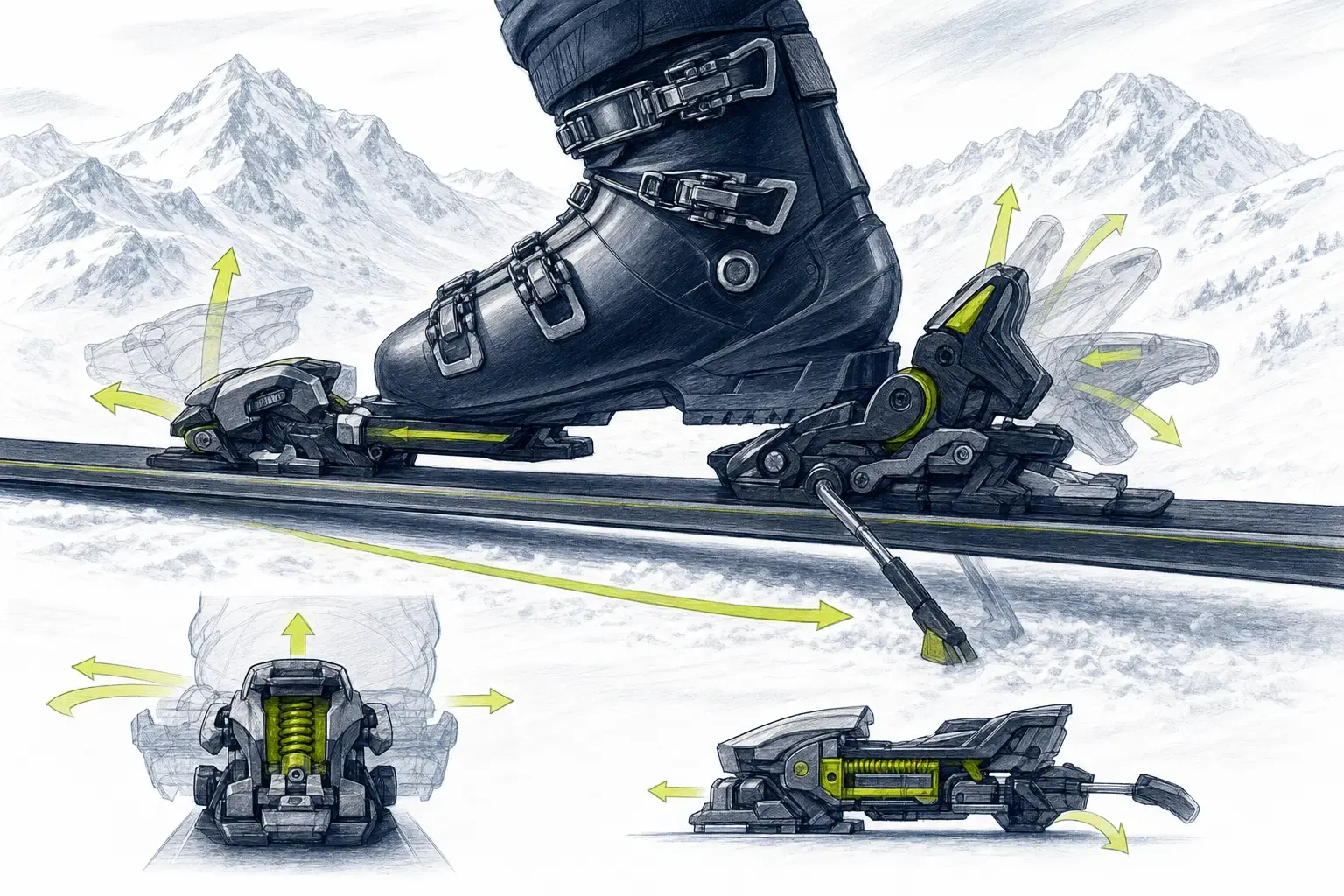
A standard alpine binding consists of a toe piece, heel piece, adjustment mechanisms, and a ski brake. The toe and heel hold the boot in the designated position; depending on the design, they allow release in different directions. After release or when the boot is taken off, the brake drops down toward the snow and limits the ski’s free movement. However, it does not guarantee that the ski will stop immediately on every surface.
Basic requirements and test methods for alpine bindings for children, juniors, and adults are governed by ISO 9462:2023. Mounting, adjustment, and inspection are assessed not only on the binding itself, but on the entire ski - binding - boot system, also referred to by the abbreviation S-B-B. This area is governed by ISO 11088:2023.
Release is a compromise, not absolute protection
A binding has to balance two opposing requirements. During normal skiing, edging, riding over bumps, and athletic loading, it must hold the boot. In some falls or excessive loads, it must allow the boot to release. No setting can recognize every fall or eliminate injury.
A setting that is too low can lead to unwanted release while skiing. A setting that is too high can limit release in a fall. A higher number therefore does not by itself mean a better, more athletic, or safer setting.
What does “DIN” mean
The numerical scale on the toe and heel is commonly called the DIN value. More precisely, it is an indicator value for release adjustment. It is not a number that can be reliably determined only from the skier’s age, weight, or skill level.
Professional adjustment works with the data prescribed for a specific system and intended use, especially the skier’s body measurements, the boot sole length, and the category of skiing style. The selection of release moments is covered by ISO 8061, and the check is carried out with a measuring device designed for testing bindings. The number visible on the scale therefore does not replace a functional test.
During mounting and inspection, service also checks other parameters, such as heel position, boot pressure, toe setting, the condition of sliding and contact surfaces, and the function of the brake. The exact procedure depends on the binding model and the manufacturer’s instructions. Adjustment screws are not intended for trial-and-error changes on the slope.
Boot and binding compatibility
The fact that a boot can be mechanically clicked into a binding does not yet confirm correct compatibility. Alpine boots, boots with a profiled sole for easier walking, and ski touring boots may use different sole shapes and dimensions. When testing bindings, ISO 9838 distinguishes test soles corresponding to alpine boots, ski touring boots, and boots with a sole according to ISO 23223.
Compatibility must be explicitly stated by both the binding and boot manufacturer. This also applies to systems labeled, for example, GripWalk. An incorrect combination can change friction, the boot’s position, or the release behavior.
Before stepping in, snow and ice must be removed from the boot sole and from the binding. Dirt under the toe or heel can prevent the boot from seating correctly. After stepping in, the heel must be fully closed and the boot must not sit crooked in the binding.
Binding in children’s skiing
Children’s bindings are chosen according to the child, the boot, the ski, and the range of use. What matters is not only whether the setting “fits” on the scale. The binding must have a suitable working range, be compatible with the children’s sole, and be mounted correctly on the specific ski. ISO 9462 explicitly covers bindings for children, juniors, and adults.
After a child grows, gains or loses weight, changes ski boots, or changes sole length, the binding setting should be checked again. The same stated ski boot size does not necessarily mean the same sole length in millimeters.
A parent or coach should not increase the release value just because the binding released once for the child. First, the circumstances of the fall, how the boot was fastened, snow under the sole, compatibility, and technical condition must be assessed. Repeated unintended release is a reason for professional inspection, not for automatically tightening the binding.
Race bindings
Race bindings are usually designed for high sporting loads and may have a different adjustment range than recreational or kids' models. That does not mean every racer needs a high release value. The setting must still relate to the specific athlete and the entire system of their equipment.
FIS issues separate specifications for competition equipment. For season 2026/27, the current specifications are valid from July 2026. However, competition rules and equipment technical limits do not replace the individual service setting of the binding.
Typical mistakes
- setting the release only according to an online chart or the child's weight,
- confusing the number on the scale with the result of a functional test,
- using a ski boot with an incompatible sole,
- fastening ski boots with snow or ice on the sole,
- adjusting the screws on your own on the slope,
- leaving the original setting after changing ski boots or after the child has grown,
- assuming a higher value is automatically safer at high speed,
- continuing to use the binding after a hard impact or visible damage without inspection.
Coach's view
Before skiing, the coach visually checks whether the boot is properly fastened, the heel is closed, the brakes are free, and the binding shows no visible damage or ice buildup. This kind of check is useful training practice, not a replacement for a service test.
Installation, changes to release values, and functional measurement should be carried out by qualified service according to the current standard, the manufacturer's documentation, and the data for the specific skier. For children, it is advisable to repeat the check whenever the boot, sole length, body parameters, or the way the equipment is used changes.
Sources and further reading
- FIS – Specifications for Alpine Competition Equipment 2026/27
- ISO 9462:2023 – Alpine ski-bindings: Requirements and test methods
- ISO/TC 83/SC 4 – Snowsports equipment: catalog of standards including ISO 11088:2023 and ISO 11087:2015
- ISO 8061:2019 – Alpine ski-bindings: Selection of release torque values
- ISO 9838:2023 – Alpine and touring ski-bindings: Test soles for ski-binding tests
- ISO 13992:2014 – Alpine touring ski-bindings: Requirements and test methods
- ISO – Catalog of standards for winter sports equipment