What ski goggles are
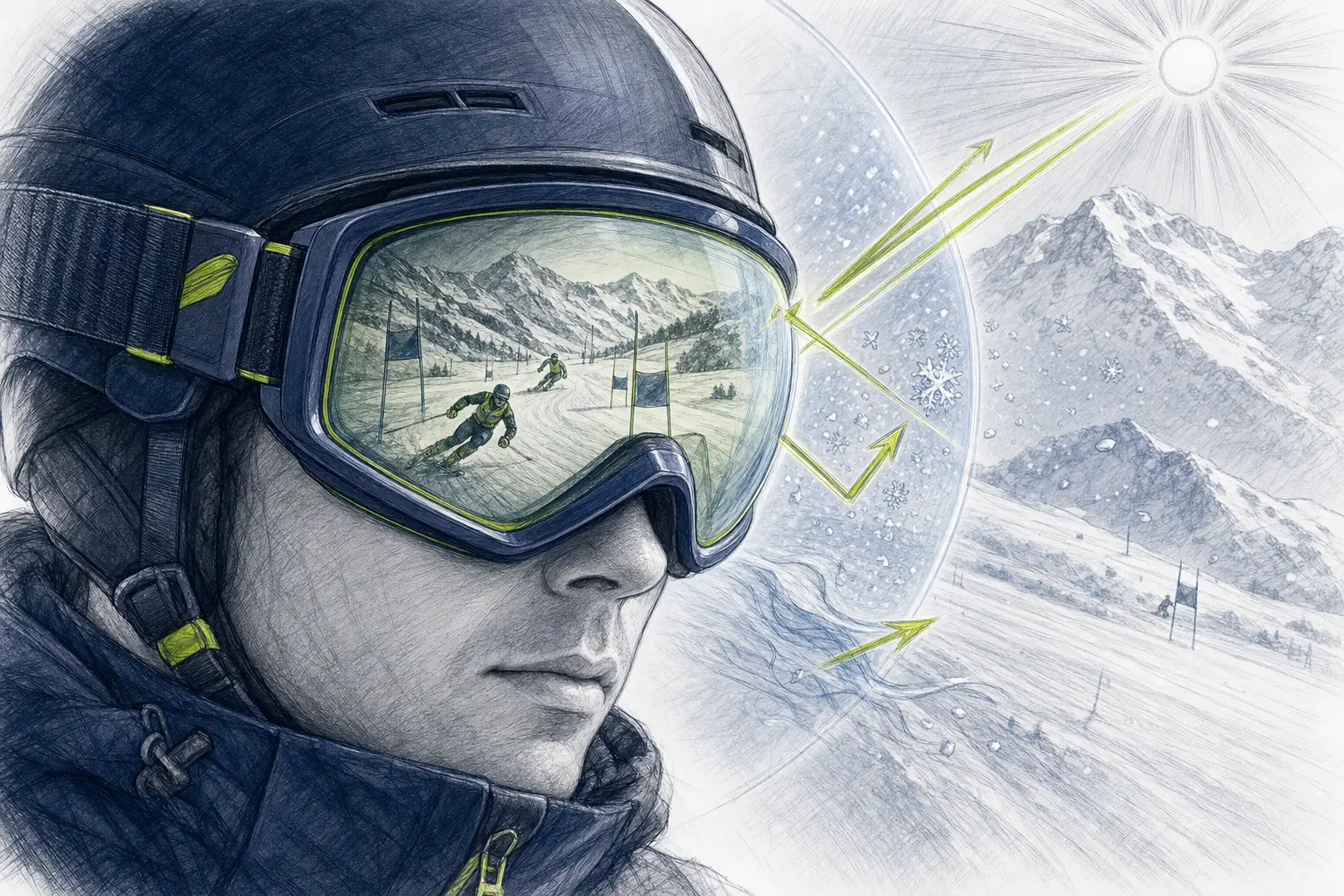
Ski goggles are protective gear with a frame, lens, and adjustable strap, designed for alpine skiing, snowboarding, and similar winter sports. Standard ISO 18527-1 covers protection against ultraviolet and visible solar radiation, rain, snow, and wind. It also sets requirements for materials, optical properties, testing, marking, and manufacturer information.
Goggles should let a skier clearly follow the snow surface, bumps, obstacles, gates, and the movement of other people without distracting optical distortion. They are not a substitute for a helmet or face protection and do not guarantee protection in every impact.
Lens and light conditions
When choosing a lens, its technical specifications matter more than the color itself. The manufacturer may state visible light transmission, often abbreviated VLT. Higher transmission is usually used in fog, snowfall, and low light, while lower transmission is used in strong sun. One universal lens is therefore always a compromise.
Protection against UV radiation should be checked according to the manufacturer’s labeling and documentation; the dark appearance of the lens alone is not a technical measure of UV protection. Eye protection is especially important on snow, because reflected light adds to direct radiation. Intense UVB exposure can cause photokeratitis, also known as snow blindness.
How goggles should fit a child
Children’s goggles should not just be a smaller version based on the age label on the package. The face shape, nose width, frame size, and the specific helmet matter. When trying them on, check whether:
- the frame rests evenly without painful pressure on the nose and cheeks,
- the lens does not restrict side or downward vision,
- the child can breathe freely through the nose,
- the goggles do not shift when the helmet is on,
- there is no significant uncovered gap between the top edge of the goggles and the helmet,
- the strap holds the goggles without the need for excessive tightening.
EU legal requirements for personal protective equipment require, among other things, minimizing any restriction of the field of vision, adequate optical neutrality, and an anti-fog solution where needed. Goggles sold as personal protective equipment in the EU must have CE marking and the manufacturer’s accompanying information. However, CE does not confirm that a particular model fits a particular child correctly.
A child who wears prescription glasses needs a model specifically designed to be worn over glasses or a system with a prescription insert. It is not enough to force prescription glasses under any frame; pressure can worsen comfort, ventilation, and stability. Standard ISO 18527-1 also covers ski goggles equipped with an insert for prescription lenses.
Fogging and care
Fogging is caused by moisture, snow in the vents, an improper fit between the goggles and the helmet, or a sweaty balaclava tucked under the frame. In training, it makes sense to first adjust the fit, clear snow from the vents, and let the goggles dry. The lens should be cleaned and dried according to the manufacturer’s instructions, because its inner surface may have a delicate anti-fog coating.
Races and the coach’s view
FIS published the specifications for alpine racing equipment for the 2026/27 season, effective from July 2026; in races, the current document for the given season and the organizer’s rules therefore apply. In the FIS wording for the 2025/26 season, ski goggles were described as equipment that protects the eyes from weather and radiation, and their use was recommended; reshaping them to gain an aerodynamic advantage was prohibited.
Before a run, the coach mainly checks clear vision, that the goggles stay stable with the helmet, and that the lens suits the current light. For younger children, it is important to teach them to say early when they cannot see bumps or when their goggles are fogging up. A typical mistake is choosing goggles based only on appearance, buying a size “for later,” or changing the lens only once the child can barely make out the terrain while skiing.
Sources and further reading
- ISO 18527-1:2021 – Eye and face protection for sports use: downhill skiing and snowboarding goggles
- ISO/TC 94/SC 6 – Eye and face protection
- FIS – Event Marketing and current competition equipment specifications 2026/27
- FIS – Specifications for Alpine Competition Equipment 2025/2026
- European Union – consolidated Regulation (EU) 2016/425 on personal protective equipment
- CDC Yellow Book – Sun Exposure in Travelers
- CDC – Preventing Vision Loss