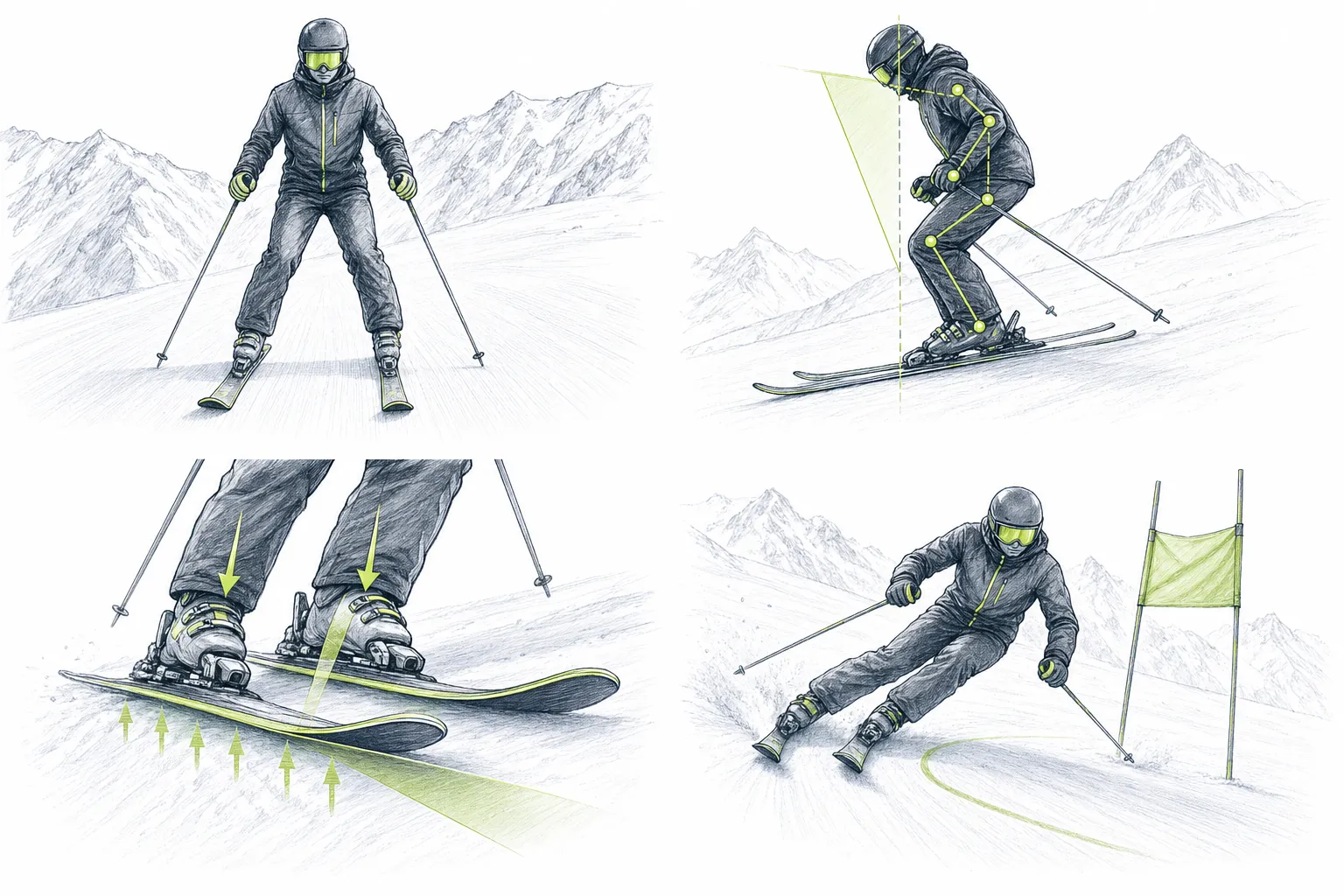
What Is Ski Stance
Ski stance is the functional alignment of the feet, lower limbs, pelvis, torso, arms, and head in relation to the skis and the snow. Its goal is not to create a pretty static position, but to allow the skier to stay balanced and guide the skis effectively.
From a biomechanical point of view, the key factor is especially the relationship between the skier’s center of mass and the feet and skis, which form the changing support surface. While skiing, this relationship changes constantly: the body and skis move along different paths, the slope angle changes, speed changes, the force acting in the turn changes, and so does the skier’s position relative to the outside ski. For that reason, a correct stance cannot be defined by one exact knee angle or a single torso position.
Basic Features of a Functional Stance
As a starting methodological model, balanced athletic stanceis used. The ankles, knees, and hip joints are appropriately bent, the torso remains naturally upright, the arms are comfortably in front of the body, and the gaze points forward. On a gentle slope during straight skiing, the skis may be parallel and the load distributed roughly between both feet. However, these features describe the starting situation, not a position that the skier should mechanically maintain throughout the entire run.
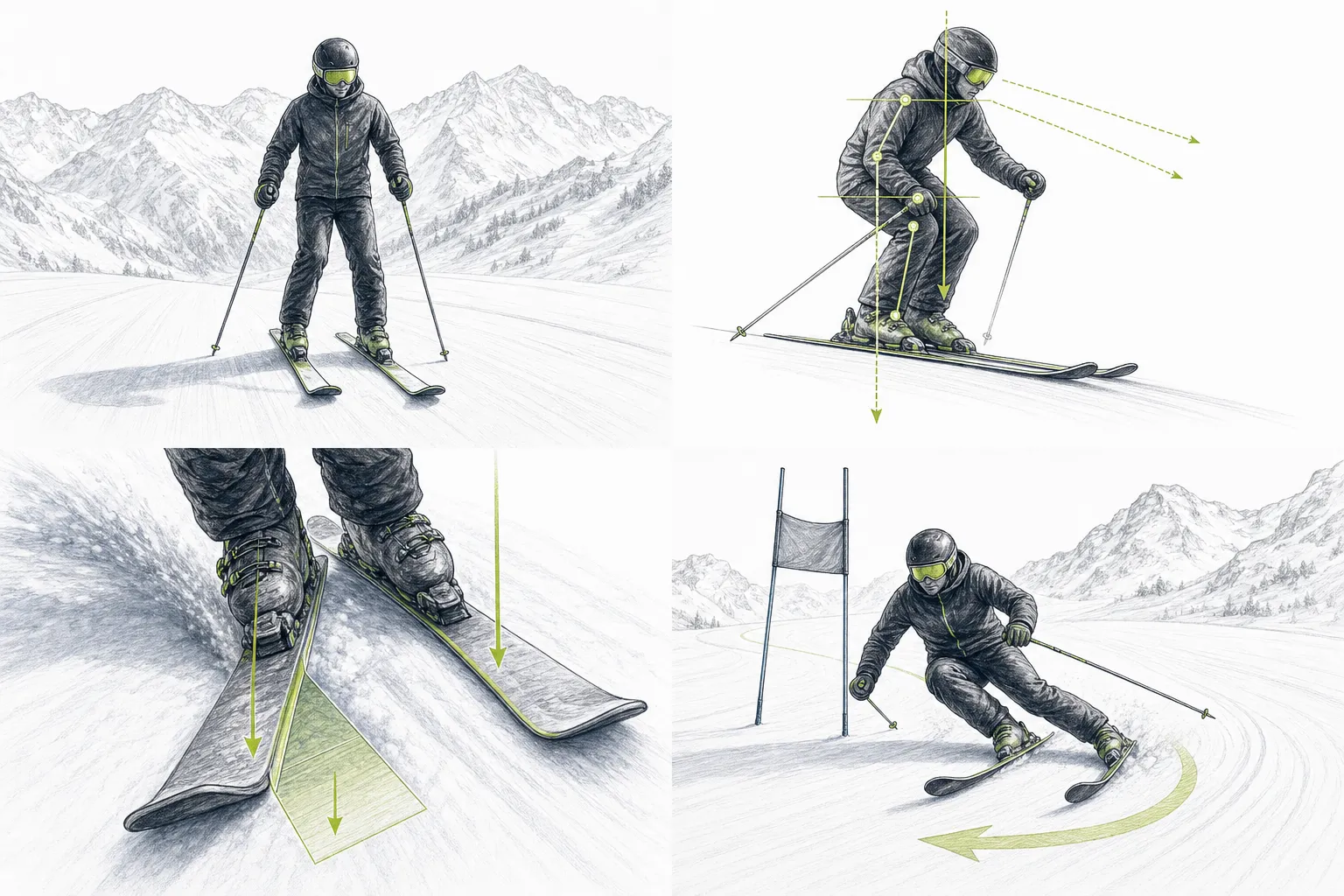
A functional stance has three interconnected dimensions:
- Fore-aft balance – the skier can adjust body position in relation to the feet and ski length. They are not constantly skiing “backseat,” but neither do they try to push the whole body forward all the time.
- Side-to-side balance – during the turn, support shifts mainly to the outside ski. The skier must be able to move the body into the turn without losing effective support on the outside leg.
- Rotational balance – the movements of the legs, pelvis, and torso are coordinated so that the skis can be guided without uncontrolled rotation of the whole body.
For this reason, the American methodology for skier development does not evaluate stance as an isolated pose, but as an adaptable skill: the skier shifts from one leg to the other, regulates pressure in the fore-aft direction, keeps the skis in contact with the snow, and changes body alignment according to the terrain and the task.
The Stance Changes During the Turn
When moving from one turn to the next, the supporting leg, edging, and direction of the forces all change. The legs bend and extend as needed, while the torso does not have to mirror every movement. In bumps, the skier may quickly pull the legs up; when building pressure, they extend them more actively. On steep slopes, in short turns, in deep snow, or in a race course, the stance therefore looks different.
Even a “centered stance” does not mean that the pressure must always be exactly in the middle of the ski. In practice, it refers to the ability to stay balanced over the skis enough to allow the next purposeful movement. A downhill racing stance, a deep crouch, or pronounced side inclination are special solutions for a specific speed and situation, not a universal model for a child beginner.
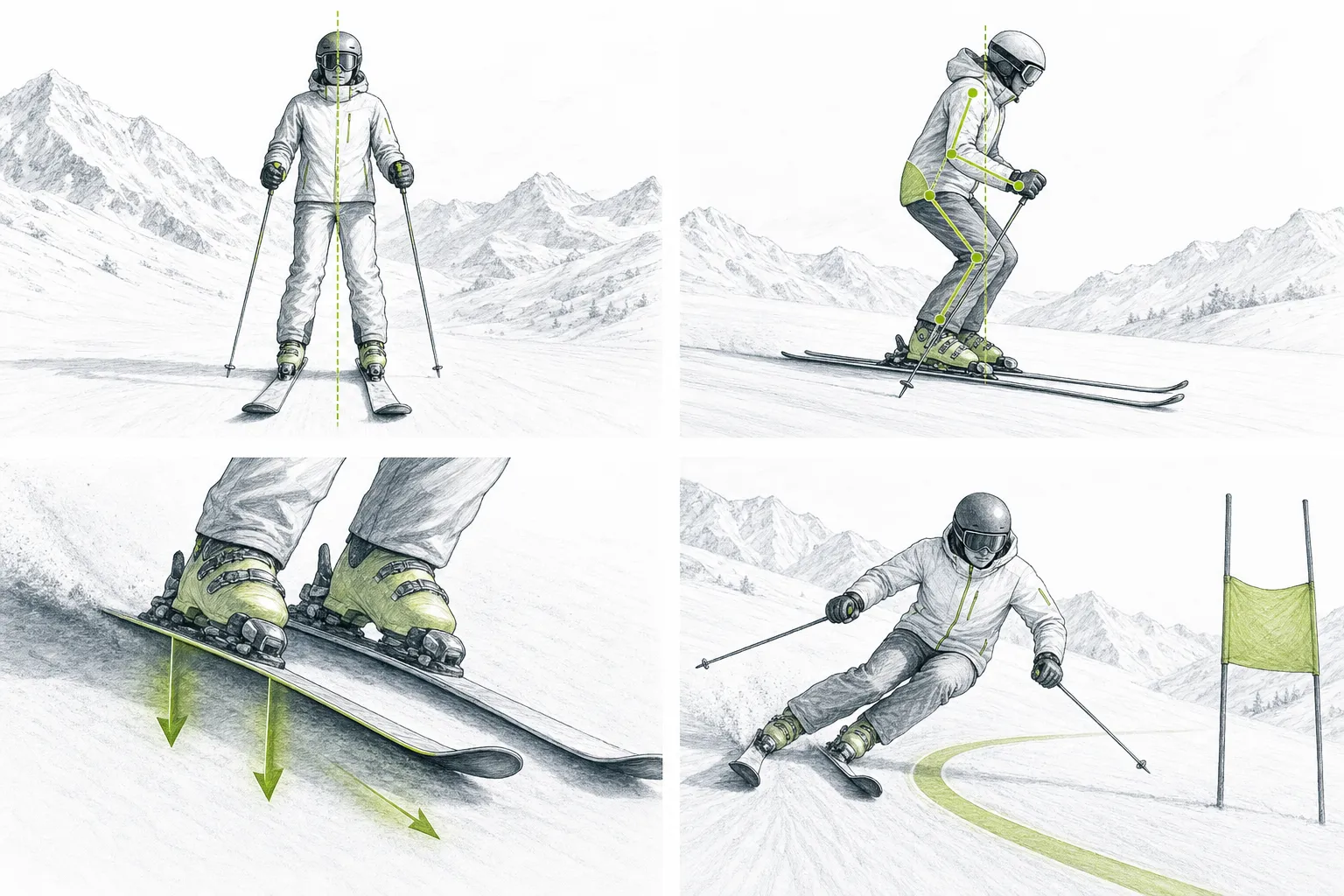
Ski stance in children
In children, stance should be assessed according to age, experience, body proportions, and the current task. A beginner in a wedge has a different support base than a young racer in a carved turn. A child therefore should not be forced into an “adult” stance, nor should parallel skis be required before they can control them in balance.
Research on young alpine skiers shows that balance is related to skiing performance, and its relationship to results can change with age and body growth. During the growth spurt, height, weight, and body proportions change, so a child may temporarily seem less coordinated. At that point, the coach should adjust the difficulty of the tasks, not just repeat the instruction “move more forward.”
Stance mobility is also influenced by equipment. The ski boot must, in its size and flex characteristics, allow appropriate ankle movement. Changes in ramp angle or heel height can alter the angles of the lower limbs and the position of the center of mass. Choosing and adjusting a child’s boot therefore belongs in the hands of a qualified shop assistant, bootfitter, or service technician; it cannot be replaced by general advice on the internet.
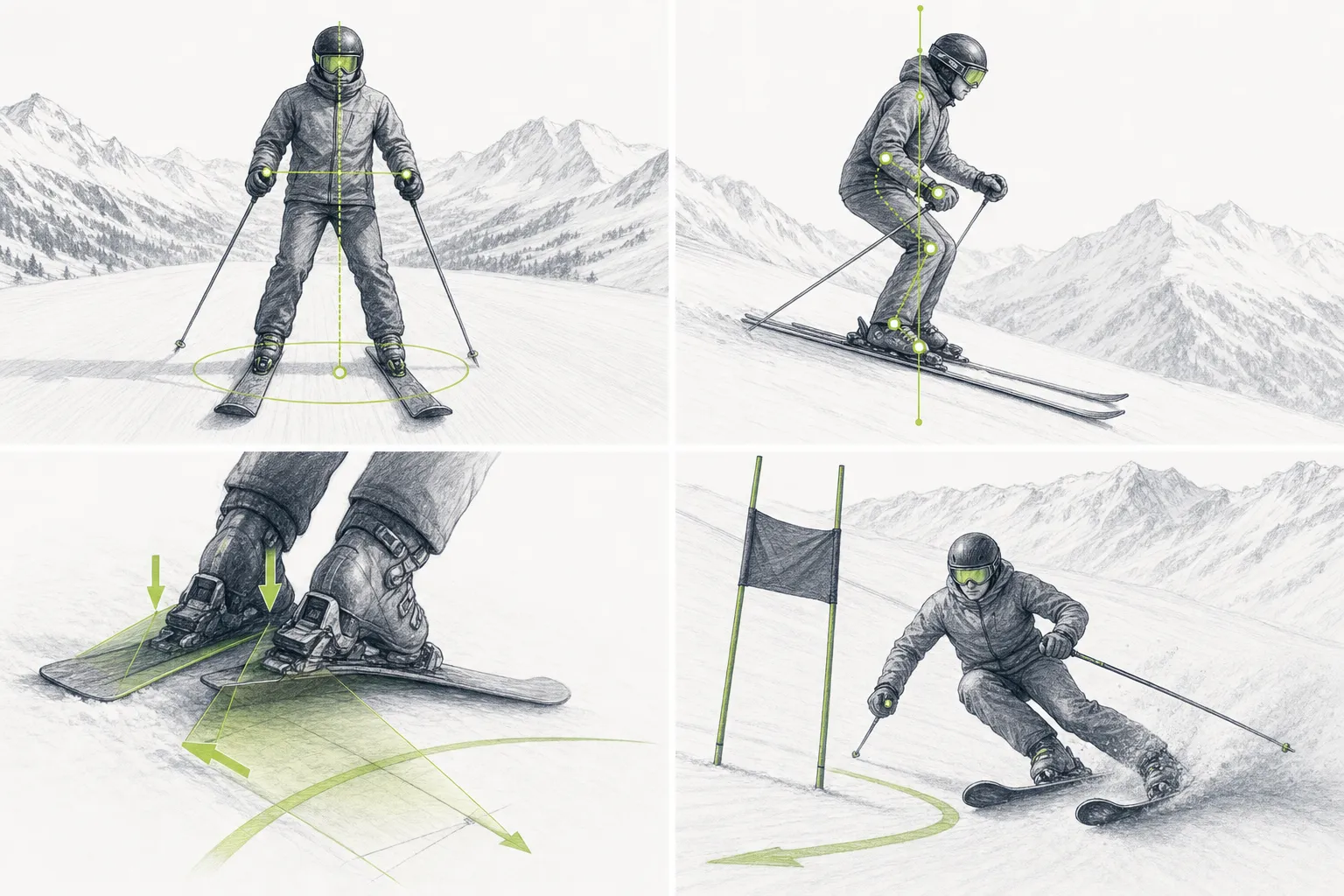
Typical mistakes and misunderstandings
- Skiing in the back seat: the pelvis stays behind the feet, the legs straighten forward, and the skier loses the ability to regulate pressure precisely.
- Static squat: the skier is low, but stiff joints do not allow them to react to the terrain.
- Overly forcing the forward position: trying to constantly push the shins hard into the tongues of the boots can limit mobility just as much as skiing in the back seat.
- Moving the whole body at once: the shoulders and pelvis turn together with the skis instead of the legs working in a differentiated way.
- Hands by the body and looking at the skis: this worsens readiness and the perception of the skiing direction.
- Copying one photo of a racer: a photo captures only an instant of a specific turn, not the whole movement process.
Coach’s view
The coach does not judge stance only by how the skier looks, but especially by what they can do from that position. They watch whether the child can change direction, release the edges, shift support to the other ski, absorb uneven terrain, and stay ready for the next movement.
In training practice, stance can be developed with simple tasks on a safe and gently sloping slope: straight skiing, alternating unweighting of the skis, small stepping movements, changing between a higher and lower position, or skiing over small terrain waves. This is not a universal training rule. The coach must adapt the terrain, speed, and task to the child’s age, equipment, and skiing level.
A good short tip says: The correct skiing stance is one from which a skier can immediately and effectively continue moving.
Sources and further reading
- U.S. Ski & Snowboard – Athletic Stance Drill Plan
- U.S. Ski & Snowboard – Level 100 Alpine Manual
- U.S. Ski & Snowboard – Athlete Performance Profile
- U.S. Ski & Snowboard – Alpine Level 300 Slalom Technique and Tactics
- Balance, Basic Anthropometrics and Performance in Young Alpine Skiers
- Frontiers in Physiology – Estimating Joint Positions and Centre of Mass Kinematics in Alpine Ski Racing
- Impact of an Elevated Rear Component of the Ski Binding on Joint Angles and Centre of Mass
- PubMed – Biomechanical Aspects of New Techniques in Alpine Skiing and Ski Jumping