Flexion is a movement in which the angle in a joint decreases. In skiing, this word usually refers to bending the lower limb at the ankle, knee, and hip. This shortens its functional length. The opposite movement is extension, that is, straightening and lengthening the limb.
At the ankle, this is usually dorsiflexion – the shin moves closer to the instep within the range allowed by the ski boot. But pressure from the shin into the boot tongue alone is not proof of correct flexion or balanced stance.
Importance in skiing
Flexion allows the skier to change stance height and the relationship between the body and the skis. Depending on direction and timing, it can help:
- adapt to uneven terrain and keep the skis in contact with the snow,
- relax or regulate ski loading,
- create space for edging under the body,
- shorten the inside leg with greater inclination,
- prepare the next extension and the development of forces in the turn.
Flexion by itself does not automatically “unweight” the skis. Its effect depends on movement speed, the direction of the forces acting, the phase of the turn, and the reaction of the skis and snow. That is why, in coaching practice, it is grouped with extension as a tool for pressure control, not as an isolated body position. The official U.S. Ski & Snowboard methodology includes it within pressure management and distinguishes turns with flexion, extension, and relatively constant lower-limb length.
Flexion in the turn
There is no single correct moment when a skier must flex. In modern racing skiing, you can observe movement solutions in which the body develops after edging and the legs gradually shorten after the fall line, so that more noticeable flexion occurs in the transition into the next turn. However, this is not a universal pattern for every turn, slope, and skier level.
Measurements of elite racers show that the range and speed of flexion and extension differ between slalom, giant slalom, and speed disciplines. The outside leg is usually more extended in the loaded part of the turn than during edging transition, while the inside leg works through a different range. Slalom requires a more dynamic change in joint angles than disciplines with longer turns.
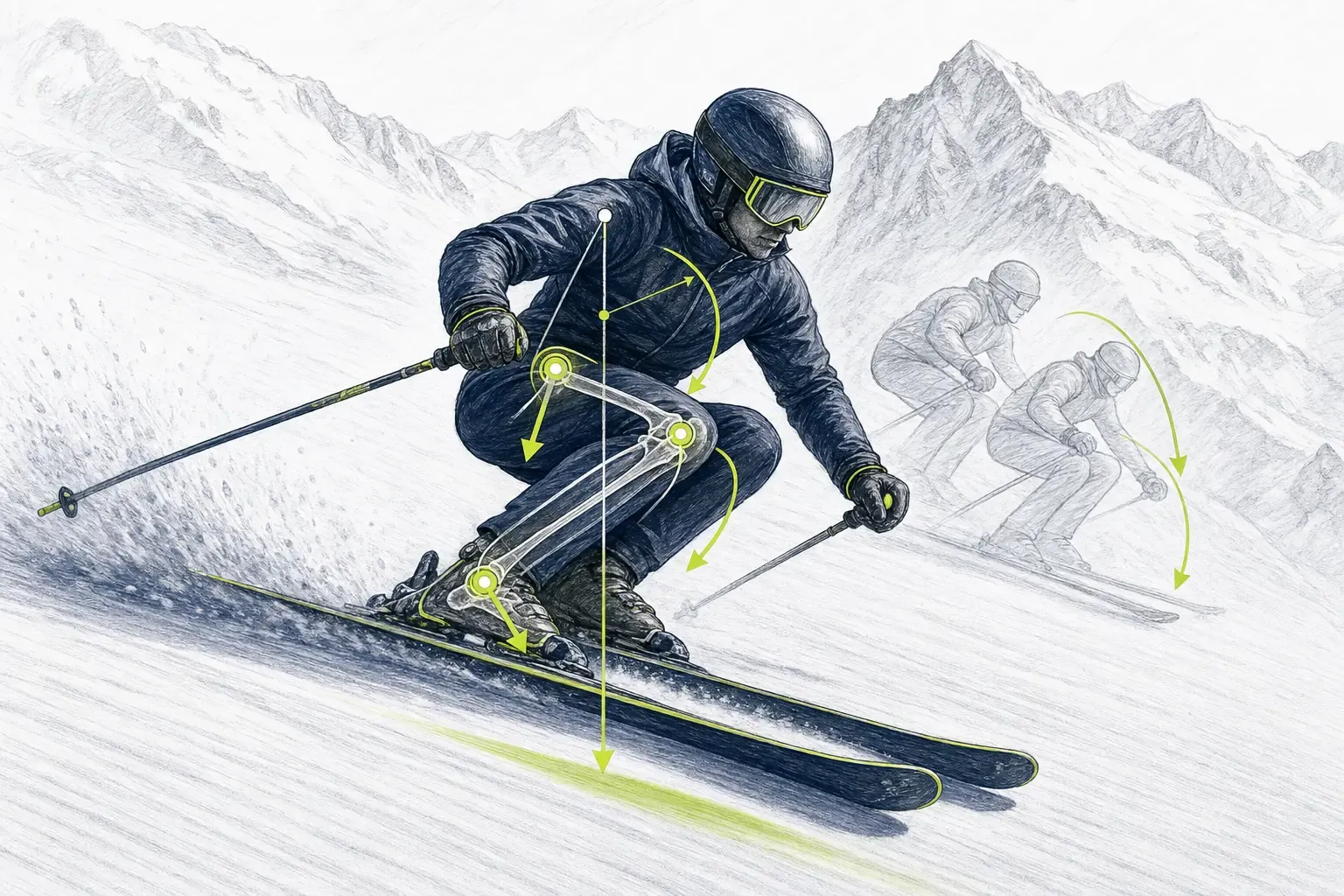
This means that instructions like “stay low all the time” or “do a squat in every transition” are too simplistic. Deep, long-held flexion can limit further movement range and increase muscular demands. A comparison of two methods of transition between turns showed that a strongly flexed transition can be more physiologically demanding than a transition based on extension; however, this result should not be mistaken for a ban on flexion itself.
Children and young skiers
For children, flexion develops mainly as the ability to change leg height and length smoothly, not as an imitation of a deep racing stance. Simple images help beginners: springs in the legs, a smooth lowering and raising of the stance, or absorbing gentle terrain undulations. The range and speed of movement must match age, balance, strength, ski level, and terrain.
Later, differentiated leg work is taught: the outside leg can provide support and lengthen, while the inside leg shortens. The goal is not to lock the outside knee or force the inside knee toward the chest, but to maintain mobility and stable contact of both skis with the snow.
Typical mistakes
- Sitting back: the skier bends mainly at the knees and hips, the pelvis shifts behind the feet, and the ankles stay too passive.
- Constantly low stance: there is not enough room for further flexion over bumps or when changing edges.
- Flexion only at the waist: upper-body leaning forward replaces the work of the lower limbs.
- Equal bending of both legs: this limits the independent action of the inside and outside ski.
- Abrupt leg retraction: it can disrupt ski-to-snow contact instead of allowing smooth pressure control.
- Forcing the knees inward: flexion is confused with edging, creating an unsuitable lower-limb position.
When evaluating, the equipment should also be taken into account. Ski geometry can change knee kinematics, so the same outside appearance does not necessarily mean the same joint work with different skis and boots.
Coach’s view
The coach does not just look at how deeply the child is flexed. They mainly assess the function of the movement: whether flexion comes at the right moment, whether it happens through the proper coordination of ankle, knee, and hip, and whether it helps maintain balance, snow contact, and the possibility of further movement. Joint angles are a measurable part of technique, but by themselves they do not capture the skier’s full coordination.
Sources and further reading
- U.S. Ski & Snowboard – Alpine Ski Fundamentals Instructor Manual, Level 100
- On-Field Ski Kinematic According to Leg and Discipline in Elite Alpine Skiers
- Recent Kinematic and Kinetic Advances in Olympic Alpine Skiing: Pyeongchang and Beyond
- Model-based Estimation of Muscle and ACL Forces During Turning Maneuvers in Alpine Skiing
- Are Existing Monocular Computer Vision-Based 3D Motion Capture Approaches Ready for Deployment? A Methodological Study on the Example of Alpine Skiing
- The Waist Width of Skis Influences the Kinematics of the Knee Joint in Alpine Skiing
- The EMG, NIRS, and RPE Responses to Two Turn Transition Techniques in Alpine Skiing