What Is an Active Stance
Active Stance is a balanced, movement-ready body position that constantly changes while skiing. The skier adjusts the position of the ankles, knees, hips, torso and arms to match speed, slope angle, turn shape, terrain and the forces acting on the skis.
The word active therefore does not mean tense or forced forward. It means that the skier can change the height of the stance, move between the skis, regulate pressure and react to bumps without unnecessary delay. The muscles are ready to work, but the body is not rigid.
Balance, Not One Prescribed Position
From a biomechanical point of view, the relationship between the body’s center of mass, the feet and the skis is important. This relationship changes dynamically through the turn. That is why the correct stance cannot be defined by one photo or by a universal knee angle.
As a basic reference, a stance is used in which:
- the skier feels stable contact with the ski boots and skis,
- the ankles, knees and hips remain ready to move,
- the torso is stable, but not stiff,
- the hands support balance and are ready to work with the poles,
- the gaze looks into the space of the next run,
- the position allows movement forward, backward, side to side, and up and down.
The ski boot limits ankle freedom, so balance cannot be handled by movement in just one joint. The ankles, knees, hips and torso must work together. Simply bending the knees without proper ankle work often pushes the pelvis back and creates a passive “seat”.
Active Stance in the Turn and in Racing
During a turn, the direction and size of the forces acting on the skier change. A functional stance therefore looks different during edge change, in the turn shape, at the exit, in a short slalom turn or when crossing a terrain wave.
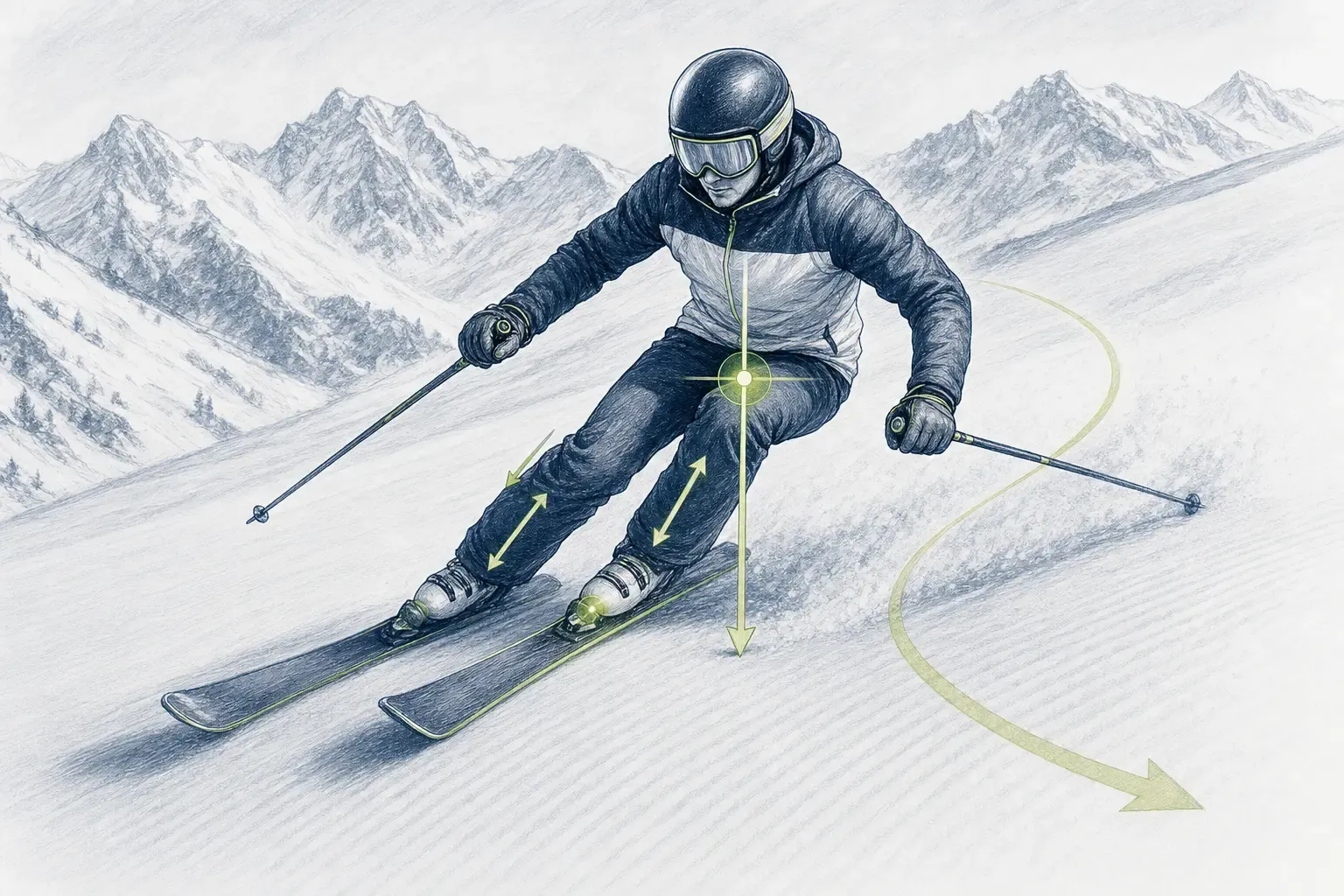
In racing skiing, balance and body position are among the basic technical areas. An active stance allows the racer to keep the skis in contact with the snow, create and release pressure at the right time, move from the outside ski to the new outside ski, and maintain torso stability with moving legs. The exact solution depends on the discipline, speed, course and phase of the turn.
Children’s context
For children, an active stance should not be taught as a rigid pose they must hold for a long time. More suitable are age-appropriate movement tasks: changes in stance width, stepping, skating, safe runs over gentle rollers, touching the knees or boots, and skiing with different arm positions. Such tasks develop balance, body awareness, and the ability to move the legs independently of the torso.
The difficulty must match the age, experience, speed, and terrain. Especially with beginners, confidence, smoothness, and the ability to react are more important than copying the stance of an adult racer.
Typical mistakes and misunderstandings
- Constantly pressing into the boot tongues: contact with the front of the boot may be part of the movement, but it is not the only sign of a correct stance.
- Squatting with the pelvis back: deeply bent knees alone do not create an active stance.
- Stiffening up: holding one position firmly limits the response to terrain and changes in pressure.
- Overly upright stance: reduces the range in which a skier can absorb bumps or actively pressure the skis.
- Looking for a perfectly static position: stance quality is assessed by how it functions in motion, not by one frozen snapshot.
Coach’s view
The coach does not watch only how the stance looks, but above all what it allows the skier to do. Important signs are smooth edge change, stable contact with the snow, the ability to shift load between the skis, independent leg action, and maintaining balance when the rhythm or terrain changes.
It is therefore best to develop an active stance while skiing and in a variety of situations. The goal is not to create one uniform pose, but a skier who can continuously organize themselves over the skis and respond effectively to what is happening beneath them.
Sources and further reading
- U.S. Ski & Snowboard – Level 100 Alpine Manual 2015
- U.S. Ski & Snowboard – Athlete Performance Profile
- U.S. Ski & Snowboard – Alpine Guide to Ski Fundamentals: Arms in Various Positions
- U.S. Ski & Snowboard – Men's Tech Reboots at Mt. Hood
- Fasel et al. – An Inertial Sensor-Based Method for Estimating the Athlete's Relative Joint Center Positions and Center of Mass Kinematics in Alpine Ski Racing
- How experienced alpine-skiers cope with restrictions of ankle degrees-of-freedom when wearing ski-boots in postural exercises
- Estimation of Alpine Skier Posture Using Machine Learning Techniques
- PSIA – Foot and Ankle Biomechanics in Alpine Skiing