What is a power strap
Power strap is a strap located at the top edge of the cuff of a ski boot. It is most often fastened with Velcro, and some versions also include an elastic section. Its job is to pull the upper part of the cuff and liner snugly against the lower leg and complement the action of the upper buckle or another closure system.
Manufacturers use different names, widths, and constructions. On junior ski boots, for example, it may be a narrower elastic strap, while sports and racing models often have a wider strap or an elastic system designed to affect how the cuff flexes. So it is not true that every power strap works the same way.
Practical meaning
A correctly adjusted strap limits unwanted gaps between the lower leg, the tongue of the liner, and the cuff. The skier can then feel contact with the boot earlier and more evenly. For elastic straps, manufacturers also mention a more progressive flex and return of the cuff.
However, a power strap does not replace the correct size and shape of a ski boot. It cannot reliably solve a boot that is too big, a loose heel, an unsuitable cuff height, or poorly adjusted buckles. It is also not part of setting the binding release force and has no relation to the DIN value.
How to adjust it
The usual training practice is first to seat the heel properly, align the liner tongue, and fasten the buckles or another closure system appropriately. After a few forward flexes at the ankles, the power strap is tightened so that it is snug but does not prevent the ski boot from flexing naturally. The exact order may depend on the design of the specific model, so the manufacturer’s instructions take priority.
There is no universal numeric value for proper adjustment. It depends on the circumference of the lower leg, the shape of the cuff, boot stiffness, the type of strap, and the skier’s ability. After tightening, the skier should be able to flex the ankles and knees in a controlled way without significant local pressure on the lower leg.
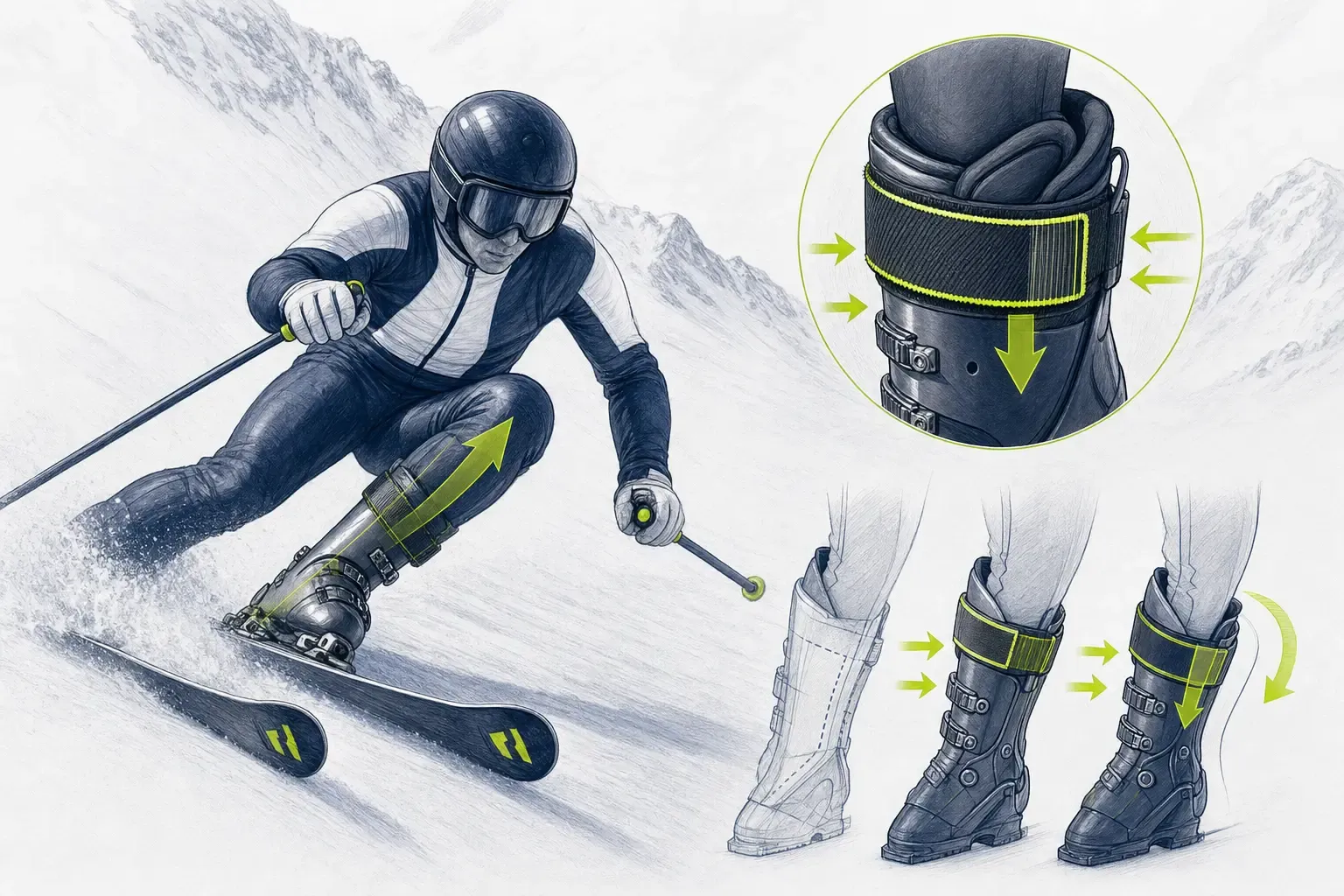
Power strap in children’s ski boots
For a child, the correct boot size, comfort, and the ability to work properly in the ankles should be decisive. The strap should not be tightened with maximum force just to make the foot feel more secure. Excessive tightening can make it harder for the child to flex the cuff and create uncomfortable pressure. On the other hand, a completely loose or unfastened strap does not perform its closing function.
The width of the strap alone does not determine whether the ski boot is suitable. Official manufacturer specifications show different solutions: junior models may use, for example, a 28 mm strap, while sports models use a 35 or 45 mm strap. It is part of the overall boot design, not a separate indicator of performance.
Adding a stiffer or elastic strap to a children’s ski boot should be discussed with a qualified bootfitter or service technician. The change can affect the feel of boot flex and may not be appropriate for the child’s age, strength, or technical level.
Racing context and a coach’s view
In competitive skiing, consistency of adjustment is especially important. The left and right ski boots should be fastened in a comparable way, and the strap should not be twisted, damaged, or routed outside the construction intended by the manufacturer. Different tightening can change the feeling of contact with the cuff, even though the strap itself cannot replace technique or properly chosen boot stiffness.
For a young skier, the coach checks whether the child can take a balanced stance and flex both ski boots smoothly. If the strap has to be tightened excessively just to keep the foot in place, the boot size, heel position, liner, and buckle settings should be checked.
Typical mistakes include using the strap as a handle when carrying ski boots, uneven tightening, trapping clothing under the strap, worn Velcro, and trying to compensate for a loose boot by tightening it extremely hard. A damaged or loosening strap should be checked by service; when replacing it, the construction and attachment method of the specific ski boot must be respected.
Resources and further reading
- Salomon S/PRO ALPHA C BOA 100 – 35 mm Velcro strap
- Salomon S/PRO SUPRA DUAL BOA 115 – 45 mm Energyzer strap
- Salomon T4 – junior 28 mm strap
- Salomon S/PRO SUPRA C BOA 130 – flexible strap and power transfer
- Atomic Redster Race Catalogue 2025/26 – technical ski boot specifications
- Atomic Alpine Race Catalogue 2024/25 – technical power strap specifications