What a closed course is
Closed course is a ski slope, a defined part of it, or a race course on which the operator, organizer, or race jury has temporarily or permanently prohibited free entry and riding. The reason may be snow grooming, poor surface conditions, technical or rescue work, race preparation, training, the race itself, or other safety and operational circumstances.
The closure applies regardless of whether the skier sees the danger. An empty, freshly groomed, or seemingly quiet slope may therefore not be open.
Closed slope for the public
On a public slope, the operator announces the closure through local signage, barriers, or staff instructions. The visitor must respect these instructions and must not go around the barrier, duck under the fencing, or continue along the closed route by following other skiers' tracks.
The Mountain Rescue Service especially warns against movement on slopes outside operating hours. At that time, machinery may be moving on the slope, snowmaking, servicing, or course grooming may be taking place. The dangerous area may not be marked as it is during regular operation. Closure may also be required by icy surface or damage to safety features.
The duties of operators and persons on ski trails in Slovakia are regulated by Act No. 544/2002 Coll. on the Mountain Rescue Service. The practical rule is clear: the operator's instruction and the closure marking are not a recommendation, but a boundary the visitor must not cross.
Closed race course according to FIS
In alpine racing, the term has a narrower and more precise meaning. According to FIS rules, a race course is closed from the start of course construction. Competitors may not enter it on their own. Access for coaches, service staff, media, and other persons is decided by the jury. Without its authorization, gates, direction markings, terrain features, or the course layout may not be changed.
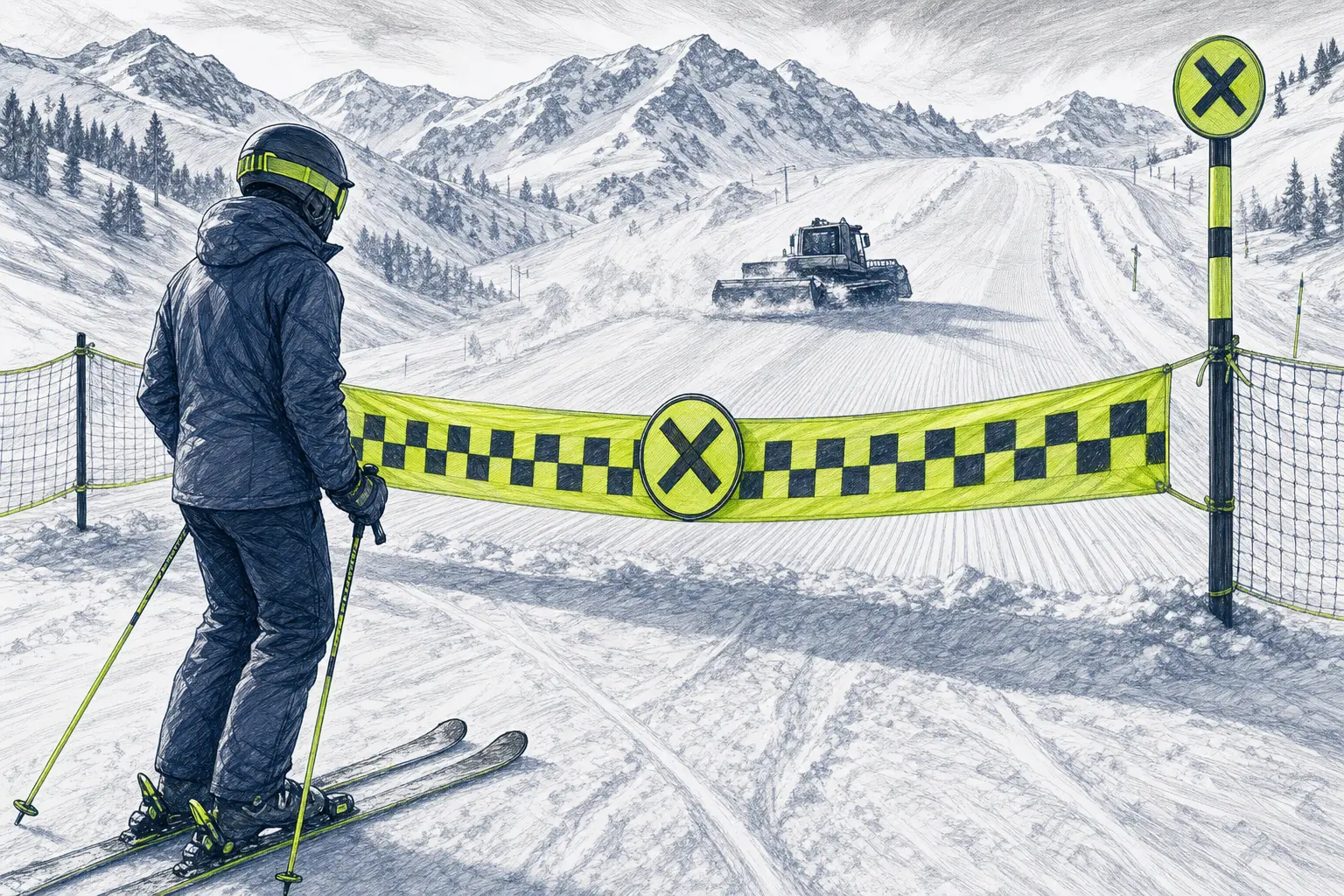
The jury or organizing committee may close the entire course or only part of it even outside race and training runs, for example for surface preparation and repair. Allowed access during inspection, training, or work on the course follows the timetable and the organizer's instructions. It does not mean general permission to ski freely down the course.
A closed course is also not a synonym of a homologated course. Homologation confirms that the course meets the relevant technical requirements for a particular discipline and level of competition. Closure expresses its current access режим.
Children's and training context
A child should be given a simple and specific message: do not go past the closure marking, even if other people are riding there. Smaller children may not correctly distinguish a course worker, a forerunner, a coach from another team, and an unauthorized skier. The movement of a person on the slope alone is therefore not proof that the course is open.
During club training, access to a reserved course is determined by agreement with the operator and the organizer's rules. The coach should explain the boundaries of the space, the place for getting on and off, the order of riders, and the procedure for interrupting training in advance. The child enters the course only on the coach's instruction and leaves it in the designated direction after finishing the run. A parent should not send a child into the gates or onto a closed section without the knowledge of the responsible coach.
Typical mistakes
- “The course is just empty.” The absence of skiers does not mean it is open.
- “The closure applies only during races.” Under FIS rules, a race course can be closed from the start of its construction.
- “If I can get around the barrier, I can keep going.” Physical passability does not change the validity of the closure.
- “A coach can always allow entry.” At races, access depends on the jury’s decision; during regular training, it also depends on the operator’s conditions.
- “A homologated course is automatically open.” Homologation and the current operating status are different things.
From a coach’s point of view, respecting a closed course is part of sports discipline. It teaches a child not only safety, but also respect for the course rules, the organizer’s instructions, and the rules that apply at races.
Sources and further reading
- FIS – Alpine Skiing Documents: current International Competition Rules and other rules
- FIS – International Competition Rules for Alpine Skiing, Art. 614.1.4 Closing and Modification of the Course
- FIS – General Regulations: FIS Code of Conduct for Skiers and Snowboarders
- FIS – What is homologation in Alpine Skiing, and why is it important?
- Slov-Lex – Act No. 544/2002 Coll. on the Mountain Rescue Service, wording effective from 1. January 2026
- Mountain Rescue Service – Call for visitors to ski resorts
- Mountain Rescue Service – The Ministry of the Interior appeals for responsible behavior in the mountains
- Mountain Rescue Service – Lower-limb injury below Chopok: warning about closed and technically prepared courses