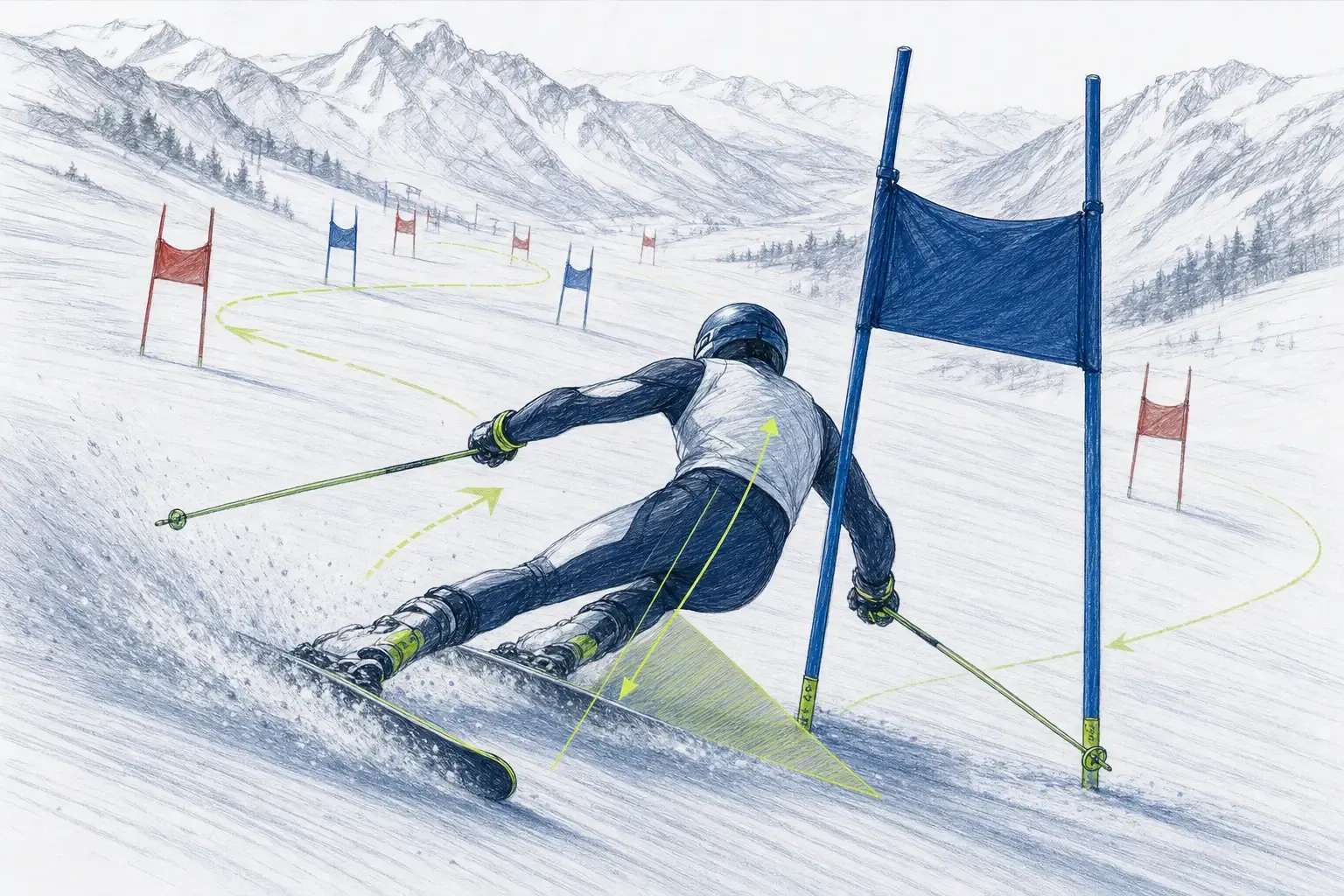
Blue gate is a race or training gate marked with a blue pole, or sometimes a blue panel. In standard alpine skiing courses, successive gates normally alternate in blue and red. The color is primarily an orientation aid: it helps the racer recognize the order of the gates, the direction of the changes, and the rhythm of the course.
What the blue color means
A blue gate is not a special type of gate and does not bring different scoring or a different required technique than a red one. Its difficulty depends on the course set, distances, terrain, slope, snow conditions, and the racer’s speed. It therefore cannot be confused with the blue marking for an easy run.
In slalom, the racer follows mainly the colored turning pole. In giant slalom and speed events, the color is also visible on the panels attached between the poles. The specific dimensions, layout, and method of building the gates are determined by the discipline and the applicable competition rules.
Color alone does not decide whether the gate is passed on the right or on the left. The correct side is shown by the position of the turning pole and the flow of the whole course. The racer must pass each gate in the manner prescribed by the rules of the discipline; missing a blue gate is judged the same as missing a red one. Contact with the pole is not a condition for a correct passage.
A special case is parallel disciplines. In them, blue can mark one of two separate parallel courses, while the other is red. The term blue course here therefore does not mean just one blue gate in an alternating sequence.
Children’s and training context
With younger children, a coach may use a simple cue such as “look to the next blue one” to get the child to lift their gaze and notice more than just the nearest pole. Later, attention expands to following several gates, changes in rhythm, and the right place to start the turn. This is training practice, not a rule for passing the gate.
A beginner should first learn to guide the skis along a safe, smooth line around the gate. An early effort to hit or knock away slalom poles can distract from balance, speed control, and finishing the turn. The course set-up and the instructions must match the child’s age, skiing level, and motor skills; a qualified coach determines the exact difficulty. Official teaching and competition materials for children’s formats emphasize a safe, smooth course and age-appropriate rhythm changes.
Common misunderstandings
- “Blue means easy.” No. Color does not rate the difficulty of the gate.
- “Blue is always passed on the same side.” No. The specific course setting decides.
- “You have to hit the gate.” No. What matters is a correct passage; contact with the pole is only a possible result of a tight racing line.
- “It’s enough to watch the colors.” Colors help with orientation, but the racer must also read the distance, direction, terrain, and rhythm.
The FIS standard uses red and blue gates. Some national rules may allow other alternating contrasting colors for their own competitions. However, such national adaptations are not automatically FIS rules, so races always follow the regulation in force for the given event.
Sources and further reading
- FIS – Alpine Skiing Documents and International Competition Rules
- U.S. Ski & Snowboard – 2026 Alpine Competition Guide (PDF)
- U.S. Ski & Snowboard – 2026 Alpine Competition Guide
- U.S. Ski & Snowboard – Alpine Competition Officials Education Resources
- U.S. Ski & Snowboard – Rules & Equipment
- U.S. Ski & Snowboard – 2025 Congress Update
- U.S. Ski & Snowboard – 2020 Masters Alpine Competition Guide (PDF)
- U.S. Ski & Snowboard – 2015 Alpine Competition Guide (PDF)