What is the ski alphabet
Ski Alphabet is a set of simple, connected movement tasks on skis. It helps a beginner build the foundations of safe movement on snow and helps an advanced skier strengthen balance, coordination, and precision in ski control.
It is not an official FIS rule or a single list of exercises performed everywhere in the same order. In professional instruction, the term is used broadly for basic ski preparation. The term screening ski alphabet also appears – a short set of tasks that a coach or instructor uses at the start of instruction to assess children’s current abilities.
What it can include
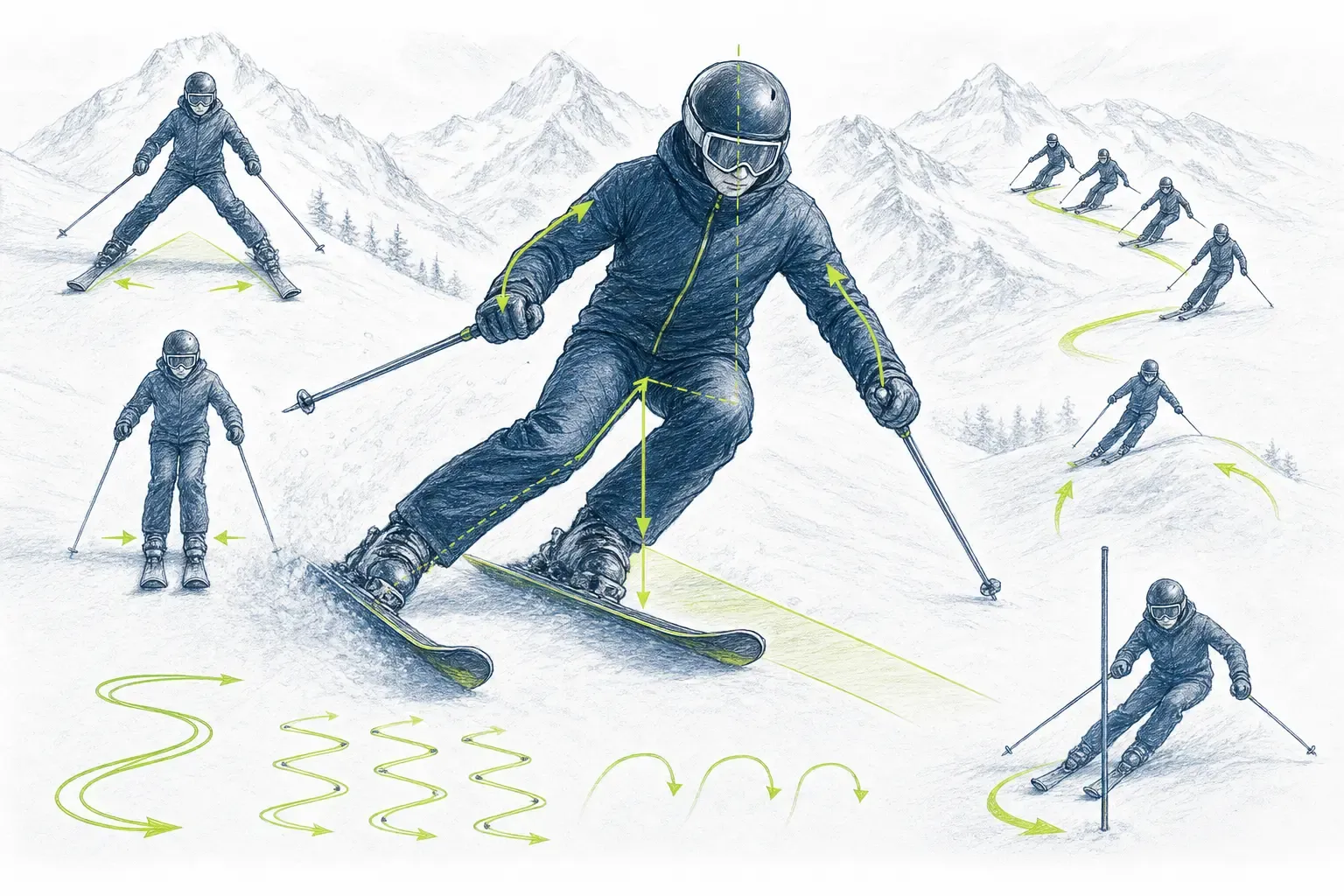
The exact content depends on age, experience, terrain, and the training goal. Typical tasks include:
- walking, turning, and moving on skis on flat ground,
- side-stepping or step-turn ascents,
- maintaining balance in a basic stance,
- gliding straight and stopping at a set spot,
- shifting weight from one ski to the other,
- lifting or unloading one ski,
- skating and pushing off,
- changes of direction with steps or simple turns,
- riding in tracks of varying width,
- going over gentle terrain bumps,
- simple hops and coordination games,
- exercises for edging, ski guidance, and pressure control.
Such a selection is not a mandatory syllabus. One exercise can have several variations, and the coach chooses it according to which skill they want to develop or observe.
Meaning for children
For children, ski basics should mainly build confidence in skiing movement. The child learns to react to glide, changing slope and snow surface, keep balance and consciously change speed or direction. The exercises also develop general coordination and spatial orientation.
For younger children, short and clear tasks are suitable, often built into a game or story. Long explanations and repeating one movement without change can lead to loss of attention. Difficulty should not be based only on age: two children of the same age may have different movement experience, strength, balance and level of fear.
Terrain, speed and group organization must match the abilities of the weakest participant. Professional teaching methods emphasize that lessons must also take into account the slope condition, snow, weather and a safe space to carry out the task.
Ski basics in race training
Basic exercises are not only for beginners. Young racers return to them during free skiing, warm-up and technical training. A simple task can reveal an unbalanced stance, weaker loading on one side, limited mobility or inaccurate ski control.
However, ski basics do not replace gate skiing. In race preparation, they create the movement foundation from which a skier draws in slalom, giant slalom and other disciplines. They are especially effective when the coach explains the link between the exercise and a regular turn or skiing on course.
Typical misunderstandings
A common mistake is to see basics as a fixed series of exercises that everyone must complete from start to finish. Another problem is using a difficult task on a slope that is too steep or too crowded. An exercise in which a child struggles with fear or high speed usually no longer develops the intended skill.
Simply managing the exercise does not yet mean that the new movement will automatically transfer into a turn. That is why a targeted task should be followed by skiing, where the skier tries the same principle in a more natural situation.
Coach’s view
Good ski basics are not a showcase of as many exercises as possible. The coach chooses a task with a clear goal, demonstrates it appropriately, watches the child’s reaction and, if needed, simplifies the terrain, speed or the task itself. More important than formally perfect execution is steadily growing control of movement, independence and the ability to use the acquired skill in regular skiing.
Sources and further reading
- Faculty of Physical Education and Sport, Comenius University – Alpine Skiing IV
- Faculty of Sports Studies, Masaryk University – Didactics of Skiing
- Faculty of Sports Studies, Masaryk University – Safety in alpine skiing instruction
- Faculty of Sports Studies, Masaryk University – Exercises in teaching alpine skiing
- Faculty of Sports Studies, Masaryk University – General ski preparation and games on skis
- Charles University – Analysis of teaching methods in ski instruction
- Faculty of Education, Charles University – Ski alphabet for selecting children of younger school age