What is a clean run
Clean Run is an informal coaching and racing term for a run in which the skier handles the task precisely, smoothly, and without a major mistake. It is not a separate technique or an official FIS rule category. Its meaning therefore depends on the situation: in drills, it may mean cleanly carved turns; in gates, a successful course run; and in free skiing, a controlled run adapted to the terrain.
Clean Ski Guidance
In a technical sense, a clean run often means a run in which the skis guide the turn mostly on edge and do not slide sideways much. In a carved turn, the front of the ski creates a track that the rest of the ski then follows. This requires a suitable combination of balance, edging, and pressure control; together with rotary movements, these abilities belong to the basic components of skiing technique.
However, a clean run does not mean that every turn must be carved without any skidding.Controlled skidding is a legitimate way to change direction and speed. In racing, a short tactical redirection of the skis can be useful if it helps handle a sharp change of direction, a delayed line, or a challenging course profile. The U.S. Ski & Snowboard development system therefore expects advanced racers not only to make turns without skidding, but also to be able to limit speed loss during an intentional skidding maneuver.
Cleanliness of the run is therefore not determined by the track in the snow alone. A coach also watches stance stability, timing of movements, smoothness of the transition between turns, support on the outside ski, pressure control, and the ability to adjust turn radius to speed, terrain, and the task.
Clean Run in Racing
In racing language, a clean run usually means a descent without a fall, a missed gate, a major deviation from the line, or a loss of rhythm. However, this does not automatically mean the fastest time. A technically smooth run can be too cautious, while a fast run can include small corrections.
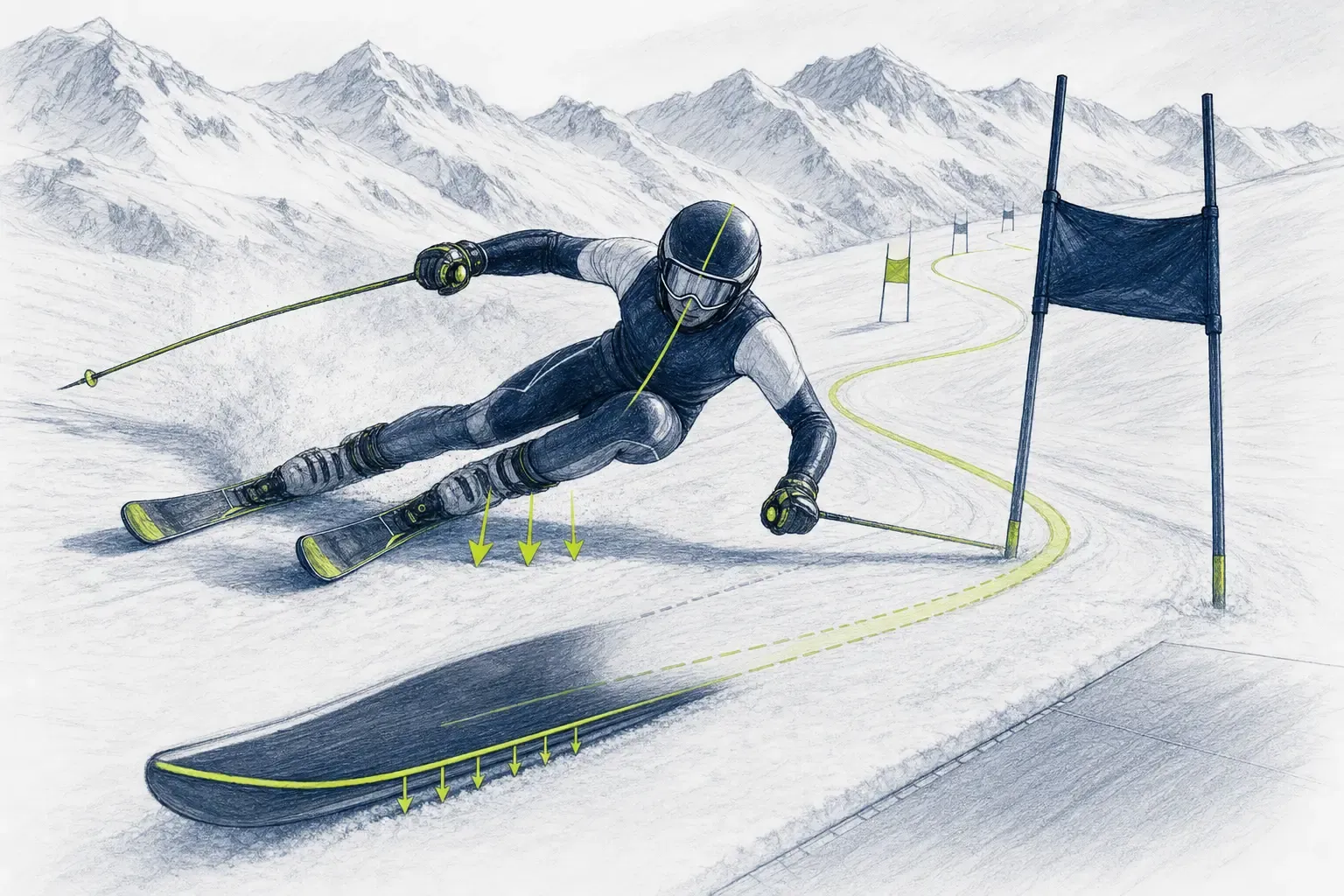
Official FIS rules do not judge results with the category “clean run.” What matters is correct passage of the course, compliance with the rules, and the recorded time. Contact with a pole alone is not the same as a mistake; what matters is correctly crossing the gate line and not breaking the rules. The current wording of the passage requirements and reasons for disqualification is determined by the International Competition Rules FIS.
Clean Run for Children
For children, a clean run should not mean a demand for perfect carving in every turn. An appropriate goal depends on the child’s level, motor development, terrain, snow quality, and speed. A beginner can show a clean run by maintaining balance independently, linking turns safely, and stopping at the designated spot. A more advanced young skier can work on more precise edging, support on the outside ski, and smooth turn guidance.
Development methods emphasize gradually learning balance, ski rotation, edging, and pressure control. Exercises should progress from simple movement tasks to linking turns of different sizes and shapes.
On a gentle, groomed slope, a coach can also monitor the ski track. On a steep, narrow, or hard slope, however, safe control of direction and speed takes priority. The requirement to ski “only on edge” can make a child unnecessarily faster or lead to a rigid stance.
Typical Misunderstandings
- A clean run is not the same as a fast run. Speed is the result of technique, tactics, line, conditions, and other factors.
- Not every skid is a mistake. The main fault is an unwanted and uncontrolled skid that disrupts direction, balance, or rhythm.
- Touching a gate does not automatically mean a dirty run or disqualification. What matters is a correct pass according to the rules.
- A narrow track in the snow does not by itself confirm correct technique. A skier can be unstable, too far back, or loading the inside ski improperly even in what seems like a carved turn.
- Clean skiing does not mean stiffness. Quality skiing is adaptable; the skier can change turn radius, pressure, edge angle, and amount of skid depending on the situation.
From a coach’s point of view, clean skiing is above all repeated control over the skis and completing the assigned task, not just an aesthetic impression. When evaluating a child, it is more important to name a specific element — for example, a more stable stance, a smoother transition, or a more precise track — than to use the general label “clean” alone.
Sources and further reading
- FIS – Alpine Skiing Documents: current International Competition Rules
- U.S. Ski & Snowboard – Alpine Training Systems
- U.S. Ski & Snowboard – Athlete Performance Profile
- U.S. Ski & Snowboard – Level 100 Alpine Manual 2015
- U.S. Ski & Snowboard – Level 100 Updates and Skiing Drills
- U.S. Ski & Snowboard – Level 100 Alpine Manual 2016