What is the exit from the turn
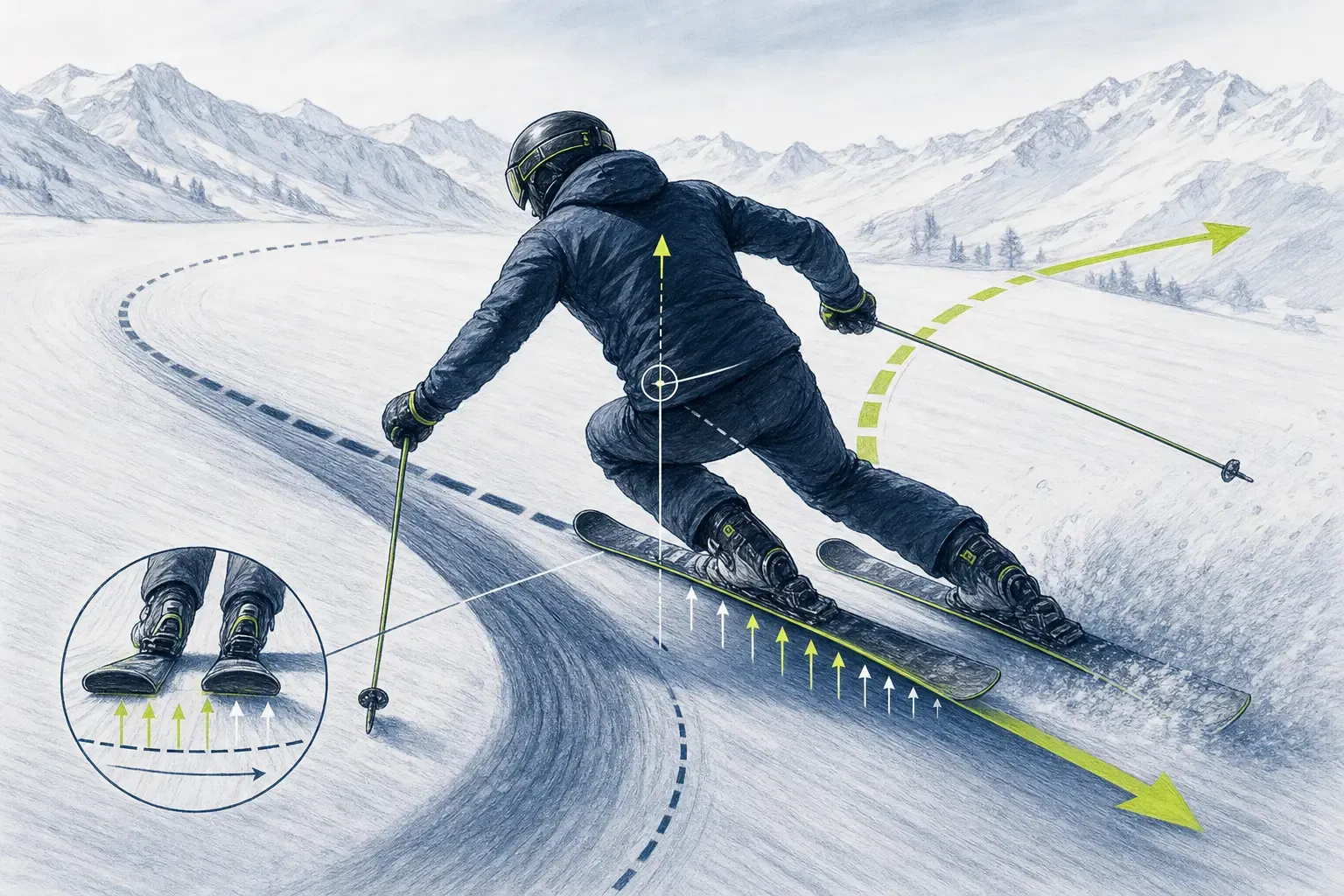
The exit from the turn is its final part, in which the skier completes the required change of direction and speed control while also beginning to release the edges and pressure before moving into the next turn. It follows the turn guidance and overlaps with the transition between turns. It is not a fixed position or a moment when the skier should stop moving.
Specialist sources do not use only one model for dividing the turn. Some distinguish initiation and guidance, while others separately describe finishing the turn, changing the load, or changing edges. In biomechanical research, the transition between turns is determined, for example, by the force curve, the unloading of the skis, or the relative position of the ski path and the center of mass. Therefore, the exit cannot be defined by a single universal picture or an exact percentage of the turn duration.
What happens during the exit
The skier is still using the effect of the old turn, but gradually reduces edging and changes the distribution of pressure. The old outside ski stops being the main support, the skis move toward a flatter position on the snow, and the new edges are prepared. When linking turns, it is one continuous movement: the end of one turn is also the preparation for the next.
The shape of the exit is influenced mainly by:
- direction of travel – a more completed turn sends the skis more across the slope,
- speed – a longer line across the slope and controlled skidding can reduce speed,
- rhythm – smooth release makes it possible to link the next turn without interruption,
- position for the next turn – the skier needs to leave the old support in time, not stay on it too long.
The exit does not always have to be carved. On steeper slopes, in short turns, or when deliberately controlling speed, it may include appropriate skidding. Quality is therefore not determined by the purity of the track alone, but by whether the chosen method matches the terrain, speed, and intent of the run. The mechanics of the turn change according to edging, ski direction, and their interaction with the snow.
The exit in racing
In racing, the exit is part of solving the line between gates. Finishing too long can point the skis too far across the slope and cause an unnecessary loss of speed. Leaving the turn too early, on the other hand, can lead to a line that is too direct or too low, after which the racer has to save the next turn with aggressive edging or braking.
However, there is no rule that the exit must always end in the same place relative to the gate. It depends on the discipline, course setting, slope angle, speed, and the next gate. Biomechanical analyses of giant slalom show that the force curve and the individual phases of the turn also change according to the course setting.
Children and learning the exit
For a beginner or a younger child, a coach usually does not explain the release as an isolated biomechanical phase. It is more understandable to work with the result: finish the turn into the intended direction, keep a smooth rhythm, and link turns without stopping or suddenly throwing the skis off.
On a gentle, clear slope, you can vary how far the turns continue across the slope, or guide the child through a corridor of soft aids. The difficulty must match the child’s age, skiing level, terrain, and ability to regulate speed. A uniform instruction like “always stand up” or “always lower yourself” is too simplistic: the professional literature describes a transition with more extension as well as one with more flexion of the lower limbs, and these strategies place different movement and physiological demands.
Typical mistakes
- Staying on the old edges: the skier holds the turn too long, gets far across the slope, and starts the next turn late.
- Abrupt upward push: instead of a smooth release, a jump or sudden unloading occurs, after which the skis are harder to guide precisely.
- Sitting back: pressure shifts to the ski tails and the skier loses the ability to release the old turn sensitively.
- Upper-body rotation: the shoulders and pelvis rotate as the main way to finish the turn instead of appropriate work by the legs and edges.
- The same release in every situation: the skier does not react to changes in slope, turn radius, surface, or course setup.
Coach’s view
The coach does not assess the release based on just one shot. They watch whether the skier reached the intended direction, how they released the old outside ski, whether they stayed in dynamic balance, and whether they could begin the next turn without corrective movements. A good release is not as long as possible or as short as possible. It is appropriate for the situation and creates a usable start for the next turn.
Sources and further reading
- U.S. Ski & Snowboard – Level 100 Alpine Manual
- U.S. Ski & Snowboard – Alpine Training Systems
- The EMG, NIRS, and RPE responses to two turn transition techniques in alpine skiing
- Course setting and selected biomechanical variables related to injury risk in alpine ski racing
- A Comprehensive Comparison and Validation of Published Methods to Detect Turn Switch during Alpine Skiing
- Comparisons of the ski turn techniques of experienced and intermediate skiers
- Mechanics of wedge turns in alpine skiing
- The Waist Width of Skis Influences the Kinematics of the Knee Joint in Alpine Skiing
- Biomechanics of Alpine Skiing – University of Jyväskylä