What is a vertical
Vertical is a slalom combination of three or four closed gates in a row. The gates are set roughly in the direction of the fall line, so the course does not shift much sideways between them. Even so, the skier must make a separate change of direction at each gate and pass the prescribed gate line correctly.
From a hairpin turn the vertical differs in the number of gates: a hairpin consists of two closed gates, while a vertical has three or four. It is not the name for moving the body up and down either. In skiing technique, that is called vertical movement and it is mainly connected with regulating pressure between the skis and the snow.
Importance in slalom
Rule: The FIS international ski competition rules classify vertical combinations as prescribed elements of the slalom course. Their number, spacing, and distances must be adapted by the course setter to the current rules, the age or competition category, and the slope homologation. For the 2026/27 season, the current edition of the FIS International Competition Rules and the relevant national regulations are decisive.
A vertical changes the character of the course. After more open gates, it brings a short, regular section with quick edge changes. The racer has little room to correct the line afterward. If the skier arrives late to the first gate, the delay can grow further at the second and third gates. According to the competition rules, a wrongly passed gate can lead to disqualification.
How to ski a vertical
A vertical starts to be prepared even before the first gate of the combination. The skier needs to choose an approach that does not require hard braking or turning the skis at once at every pole. The ski path moves from side to side, while the body’s center of mass can continue more smoothly down the course.
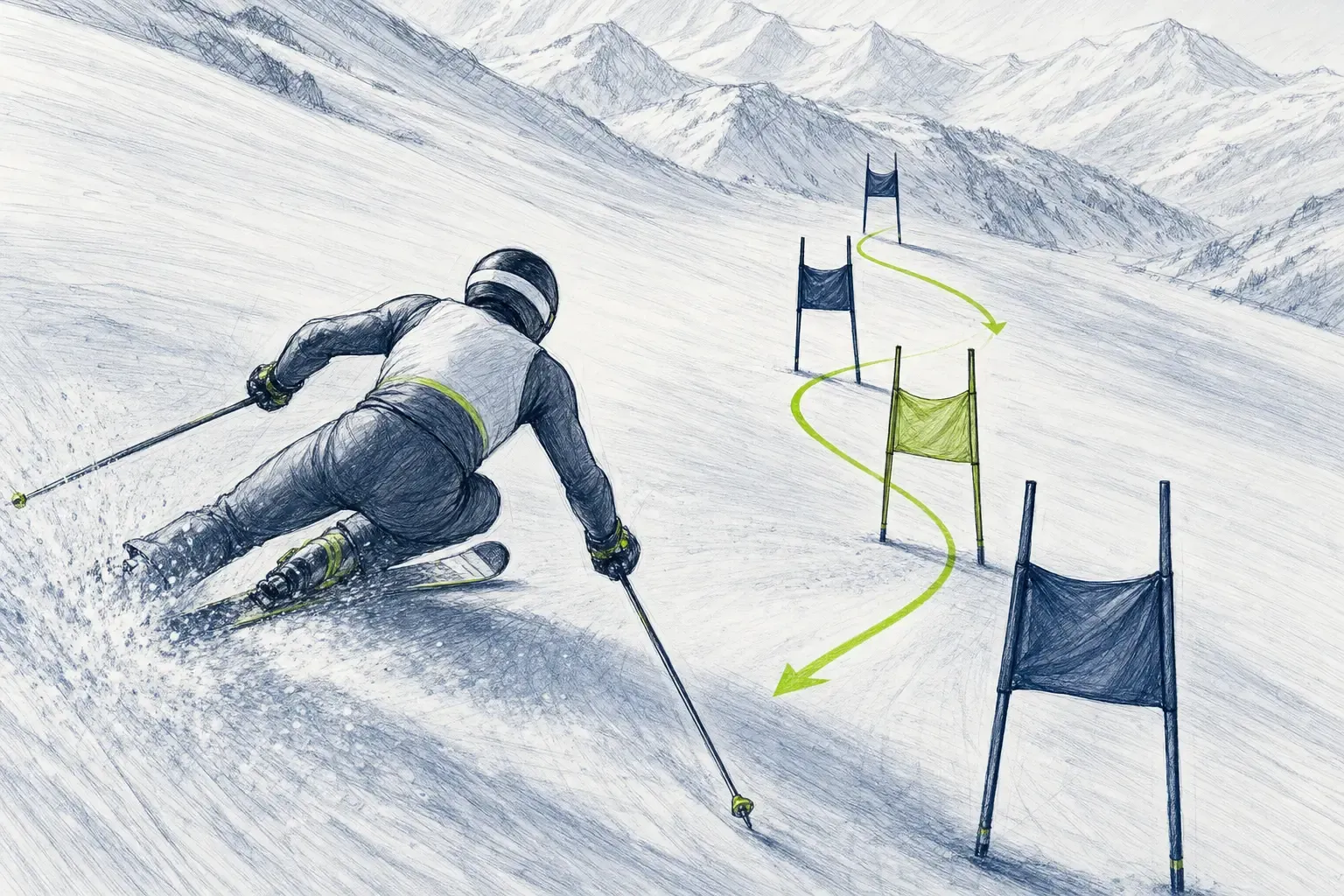
Important are:
- a precise line when entering the combination,
- quick and appropriate edge changes,
- active bending and extending of the lower limbs,
- continuous regulation of pressure on the skis,
- a stable torso without unnecessary rotation,
- view and preparation for exiting the last gate.
Leg movement does not take the form of jumping between gates. The amount of flexing and extending depends on speed, slope, surface, gate spacing, and the chosen line. Contact with the pole is not the goal in itself; what matters is a clean passage and keeping the rhythm.
Children and gradual practice
Training practice: For beginners, the vertical is not introduced immediately at race speed. The coach may first use soft brushes or short training poles, a gentle slope, and more space to prepare the entry. The child learns to perceive a sequence of several gates as one unit, but performs each change of direction consciously and in balance.
Difficulty increases according to age, motor skill level, and the skier’s confidence. Simply shortening the spacing is not the only, nor always the best, way to make it harder. The task can be varied by approach speed, slope, the position of the vertical in the course, or by combining it with open gates. However, the dimensions of the race course are always subject to the valid rules.
Typical mistakes
- Too direct an entry: the skier ends up under the next gate and has to brake or change direction sharply.
- Late turning before the first gate: the mistake carries through the whole combination.
- Upper-body rotation: the torso gets ahead of or lags behind the legs and disrupts quick edge changes.
- Stiff legs: the skis lose smooth contact with the snow and pressure comes in sudden bursts.
- Focusing only on the pole: the skier watches the contact instead of the line and the exit.
- Releasing too early after the last gate: the racer handles the inside of the vertical but ruins the entry into the next turn.
Coach’s view
The coach does not assess only whether the child hit all the gates. The focus is mainly on the quality of the entry, the smoothness of the center-of-mass path, the independent work of the legs, and readiness for the next part of the course. A good vertical does not look like a series of emergency corrections, but like a short rhythmic section connected with the turn before the combination and after it.
Sources and further reading
- FIS – Alpine Skiing Documents: International Competition Rules 2026/27
- U.S. Ski & Snowboard – Alpine Training Systems
- U.S. Ski & Snowboard – Athlete Performance Profile
- U.S. Ski & Snowboard – Level 100 Alpine Manual
- Catholic University in Ružomberok – Technique and Methodology of Alpine Skiing
- Charles University – Comparison of Teaching Methodology in Alpine Skiing in Selected Countries