What team training is
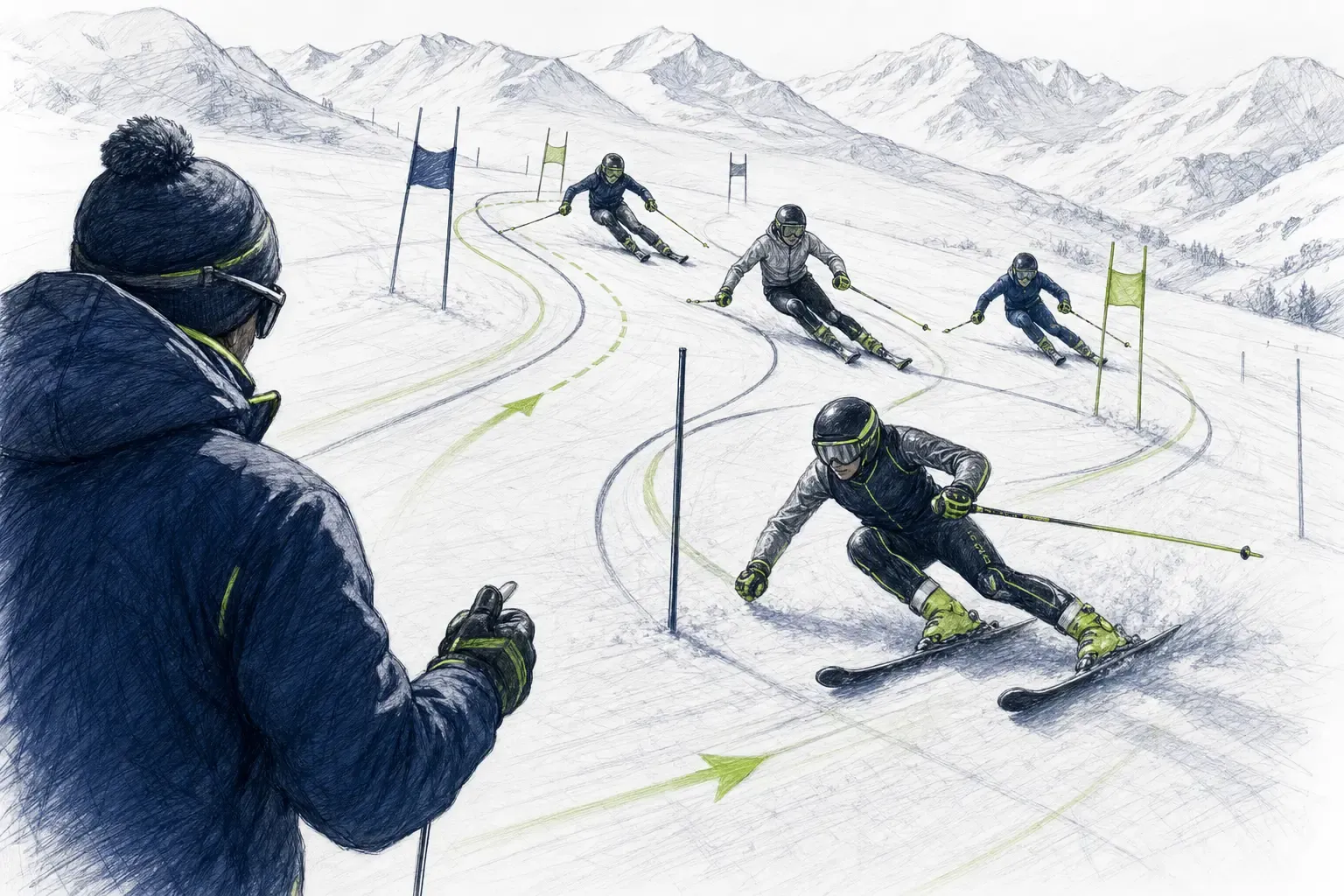
In training practice, the term team training means an organized training session in which a group of skiers works under a coach toward a common goal. It may involve developing basic movement skills, free skiing technique, gate training, physical conditioning, or practicing race routines.
However, a shared goal does not mean that everyone must complete the same course, number of runs, speed, or technical task. Quality team training combines shared organization with individually appropriate demands.
The importance of the team in an individual sport
The result in alpine skiing depends primarily on the run of the individual competitor. Even so, the club team creates an environment in which the skier learns by observing peers, comparing different solutions, following a shared routine, and accepting feedback.
A team has both a task and a social side. Task cohesion means cooperation in achieving the training goal; social cohesion describes relationships and the feeling of belonging to the group. Research in youth sport links a strong coach–athlete relationship and a task-oriented climate with higher cohesion and autonomous motivation. These findings are not specific to skiing, and they do not mean that a good atmosphere automatically brings a better race result.
Team training for children
With children, the group cannot be led only by calendar age. What also matters are experience on snow, independence, technical level, physical and motor development, the ability to understand instructions, and to move safely in the given terrain. For this reason, long-term skier development frameworks adapt training content to the athlete’s stage of development and readiness, not just to age category.
Younger children usually need short, clear tasks, frequent activity, and a minimum of idle waiting. Different levels of difficulty can be created by choosing the terrain, the distance and spacing of aids, speed, the number of repetitions, or an easier and harder version of the same task. There is no universal rule; the coach decides the specific solution according to the conditions and the group’s abilities.
An appropriate amount of choice or involving children in solving the task can support a sense of independence and competence. Research in youth sport also points out that intimidation and strongly controlling coach behavior are linked to frustration of psychological needs and weaker athletic commitment.
Organization and safety
A safety-focused organizational practice is to set the start point, direction of skiing, order, start signal, and safe stopping area in advance. Children must know where they wait and which way they return. The coach needs an overview of the whole group, not just the fastest skiers.
No universal number of children per coach can be set without context. The appropriate group size depends on the children’s age and independence, slope difficulty, weather, visibility, the type of exercise, course organization, and the presence of other coaches or helpers.
Race context
In a race team, team training also includes shared routines: warm-up, course inspection, start preparation, communication with the coach, and evaluation of runs. Shared routine, however, does not remove the racer’s individual responsibility for personal preparation, behavior, and following instructions. At higher levels, the group program is increasingly connected with the athlete’s individual performance plan.
Typical mistakes
Team training cannot be understood simply as the whole group skiing behind the coach. Common mistakes include the same level of difficulty for clearly different skiers, long waits, unclear organization, treating every run as an in-team race, or focusing only on the strongest skiers.
The coach's view should be directed toward what the group should learn and what each member needs. Shared rules, a clear goal, and mutual support keep the team together; varied tasks, observing individuals, and specific feedback ensure that every skier in the team develops as well.
Sources and further reading
- Alpine Canada – Long-Term Athlete Development: Reference Materials
- Alpine Canada – Planning for Performance
- Alpine Canada – Alpine Skiing Entry Level Coaching Course Portfolio
- Sport for Life – Long-Term Development in Sport and Physical Activity 3.0
- U.S. Ski & Snowboard – Alpine Training Systems
- Conroy, Coatsworth – Assessing Autonomy-Supportive Coaching Strategies in Youth Sport
- Vieira et al. – Coach-athlete relationship, team cohesion and motivation in Brazilian youth athletes
- Moreno-Murcia et al. – Coach autonomy support, controlling behaviours, motivation and sport commitment
- Weiss, Moehnke, Kipp – Coach and teammate motivational climate and team cohesion among female adolescent athletes