What is sidecut
Sidecut, in Slovak ski sidecut, is the curve of its side outline when viewed from above. A typical downhill ski is wider at the tip and tail and narrower in the middle. This shape allows the ski, once put on edge and flexed appropriately, to follow a curved path.
The dimensions are often written as three numbers, for example 120–70–105 mm. They indicate the ski’s width at the front, middle, and rear. However, the sidecut itself cannot be reliably judged only from the difference between these three numbers, because their position and the ski’s length also matter.
Sidecut is not the same as the ski’s longitudinal flex, camber, or rocker. Sidecut describes the side outline, while camber and rocker refer to the ski’s longitudinal profile when viewed from the side.
Sidecut radius
Sidecut radius or sidecut radius is a numerical approximation of the ski’s average side outline radius. It is given in metres. FIS defines it as an approximation of the average radius that makes it possible to describe the ski’s side shape overall. For official measurement of racing equipment, it uses specified widths and distances measured on the base; the procedure follows ISO standard 6289.
For the same ski length, the following generally applies:
- more pronounced sidecut means a smaller nominal radius,
- less pronounced sidecut means a larger nominal radius.
Length matters: two skis with similar widths may not have the same radius if they are different lengths.
The nominal radius is not the actual turn radius
The figure printed on the ski does not mean that the skier will make only turns of this size. It is a geometric parameter of the ski measured in a prescribed way, not a promised line on the snow.
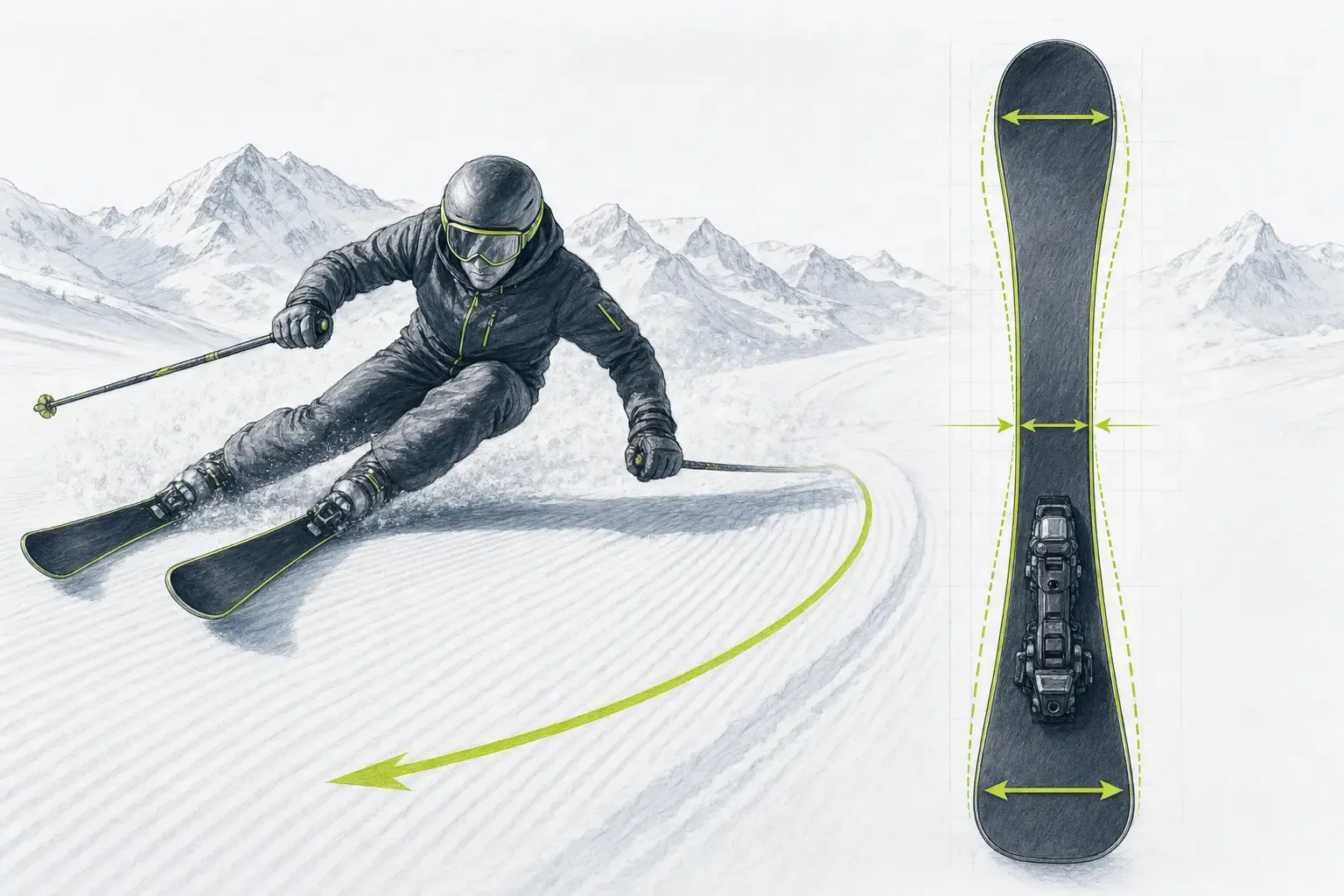
The actual turn is influenced mainly by:
- edge angle,
- the ski's flex,
- where and how the load is applied,
- the ski's longitudinal and torsional stiffness,
- speed,
- snow hardness and roughness,
- skidding or clean edge grip,
- the skier's technique and body proportions.
A ski with a smaller radius can therefore also create a longer turn, while a ski with a larger radius can, with the right edging, flex and steering, take a shorter line. In a skidded turn, the relationship between sidecut and track is even looser.
Meaning for a child skier
Appropriate sidecut can make it easier for a child to first feel that a ski set on edge starts turning by itself. But a smaller nominal radius does not automatically mean a more suitable or safer kids' ski. When choosing, length, flex, weight, construction and the child's level should all be considered together.
A beginner still often controls direction mainly by turning the legs and using controlled skidding. It is therefore not right to expect them, from the first days, to use sidecut for purely carved turns. As their level improves, they learn to combine edging, pressure and turning so they can change both the size and shape of the turn. The U.S. Ski & Snowboard methodology describes the ability to ski short, medium and long turns and later to adjust their radius even during the turn.
Race context
In competitive skiing, the radius is not just a rough manufacturer’s figure. FIS sets the method for measuring it and defines technical requirements for skis for individual disciplines and categories, including radius, length or width. Exact limits must therefore always be checked in the rules valid for the specific season and event. For the 2026/27 season, FIS published separate alpine racing equipment specifications effective from July 2026.
A recreational figure on a ski and an officially verified parameter of a race ski are not the same thing from the point of view of the rules. When buying race skis for a child, you should follow the current organizer’s rules, the age category and the discipline, not just the model’s commercial name.
Common misconceptions
- A smaller radius always means a shorter turn. No; the final track is shaped by the interplay of geometry, flex and ski control.
- The ski turns by itself. Sidecut helps guide the turn, but the skier must control the edges, pressure, balance and leg steering.
- Three dimensions fully describe ski behavior. They do not describe its stiffness, flex or the full distribution of the side shape.
- The smallest radius is the easiest for a child. A ski that is too aggressive or too stiff may be unsuitable for a child’s weight and technique, regardless of the stated radius.
Coach’s view
The coach does not use sidecut as a substitute for technique, but as a feature of the equipment that the child learns to use gradually. The goal is not for the skier to passively follow a single ski radius. They should be able to change the shape of the turn according to terrain, speed, and task, and recognize the difference between edging and controlled skidding. When evaluating, it is necessary to distinguish what the ski’s geometry makes possible from what the skier actively creates.
Sources and further reading
- FIS – Event Marketing: Specifications for Alpine Competition Equipment 2026/27
- FIS – Alpine Skiing Documents: current rules and documents
- FIS – Specifications for Alpine Competition Equipment 2025/26, revision 14. July 2025
- FIS – Specifications for Alpine Competition Equipment 2025/26: definition and calculation of the sidecut radius
- FIS – Specifications for Alpine Competition Equipment 2025/26: dimension and radius tables
- U.S. Ski & Snowboard – Alpine Training Systems