What is a short turn
Short turn is a series of smoothly linked parallel turns with a small radius and a short duration. The skier moves in a fairly narrow corridor, keeps a regular rhythm, and controls speed mainly by directing and finishing the turns. The word short does not mean one fixed value in meters. The size of the turn is assessed in relation to the skier’s body, skis, slope steepness, and the specific task.
In teaching methodology, the short turn is also often described as a short parallel turn or a short-radius turn (short-radius turn, Kurzschwung). The technical prerequisite is a mastered parallel turn: the skier must be able to maintain balance, change edges, and guide both skis in parallel without starting each new turn with a wedge.
How a short turn works
Compared with a medium or long turn, the skier must edge and steer the skis faster and repeatedly adjust pressure. The legs work dynamically beneath a relatively calm and stable upper body. Movement of the pelvis and center of mass into the new turn enables the edge change; flexing and extending the lower limbs helps regulate ski-snow contact and the pressure build-up.
A short turn does not always have to be purely carved. On a gentle, firm slope it can have a strong carved component, while on steeper terrain it is combined, depending on the situation, with edge guidance and controlled skidding. What matters is not the track at any cost, but balance, the intended shape of the turn, and speed control.
In advanced execution, pole planting helps set the rhythm and the timing of the transition into the next turn. However, it should not replace leg work or serve as a forceful support around which the skier turns the whole body. Swiss methodology describes pole use as an aid for timing, support, and initiating the turn.
Importance for children and young skiers
With children, the short turn is not learned just by quickly flicking the skis. First, they need a stable parallel stance, the ability to vary turn size, and the ability to maintain similar speed through repeated turns. The difficulty should match the child’s skiing level and motor skills, not just their age. The American development system therefore describes short, medium, and long turns relative to the skier’s body size.
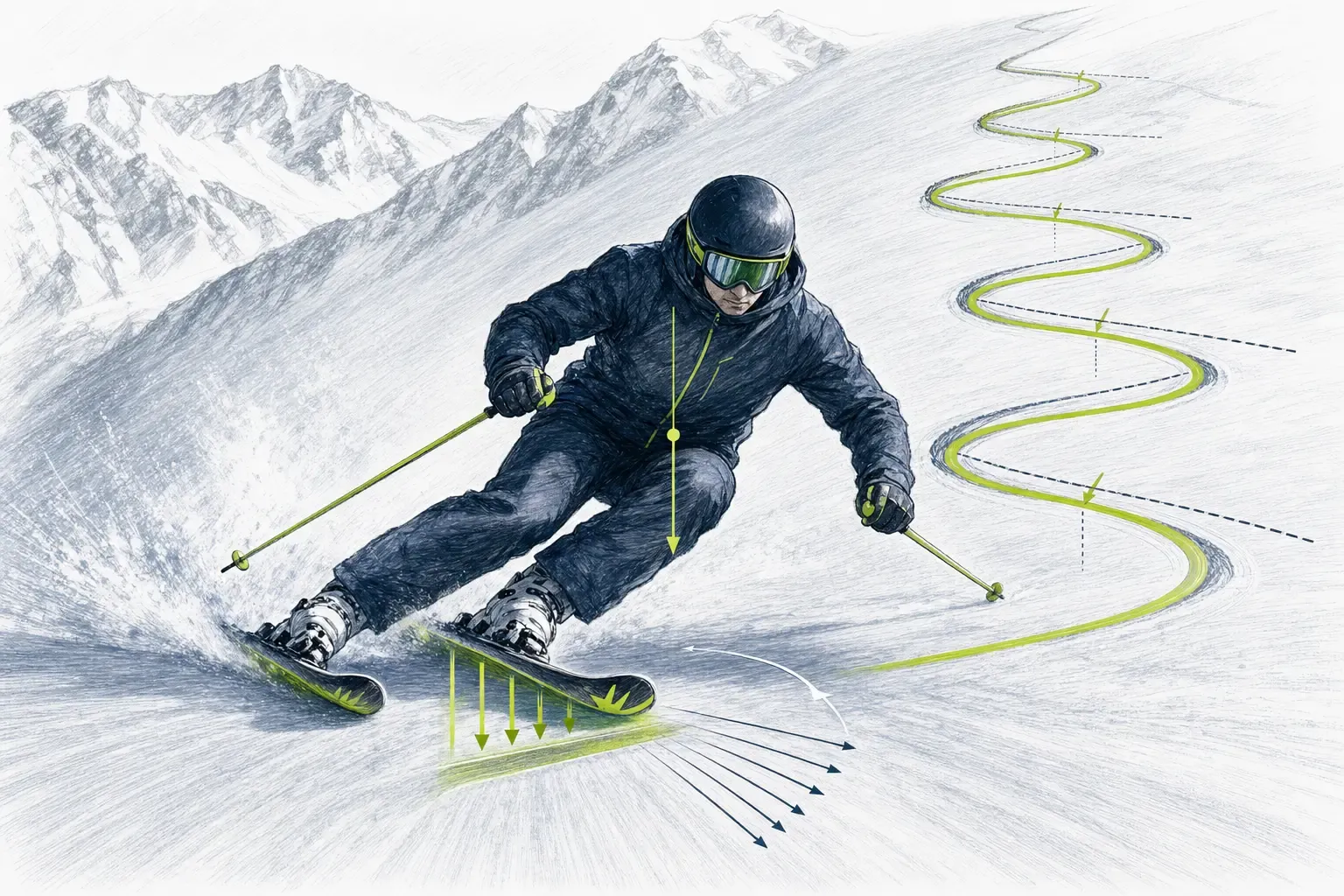
Training practice: a suitable preparation is skiing in a wide corridor that gradually narrows, or an hourglass-shaped exercise: the skier smoothly shortens the turns and then lengthens them again. This task shows whether the child can consciously change turn size without suddenly losing rhythm, balance, or speed control. U.S. Ski & Snowboard uses this type of exercise in the SkillsQuest program to develop fine movement control and line planning.
Initial practice belongs on a clear, groomed slope with appropriate steepness. Steeper terrain, short turns in uneven snow, and highly dynamic variations are the next stage, not the starting task for a child who has not yet mastered continuous parallel turns.
Racing context
The short turn is an important part of general ski preparation for slalom. It develops quick edge changes, rhythm, precise ski direction, and the ability to adapt turn radius. U.S. Ski & Snowboard directly presents it as a foundation that prepares young athletes for successful slalom skiing.
However, a free short turn is not the same as skiing a slalom course. Between the gates, the racer must adapt the line to the course setting, steepness, snow surface, and speed. A short turn without gates is therefore primarily a technical exercise, in which the coach can separately observe movement quality and the ability to change turn shape.
Typical mistakes
- Quick flicking without turn shape: the skis move mainly side to side, but the skier accelerates straight down the fall line.
- Turning the whole body: the shoulders and torso rotate together with the skis instead of the turns being made primarily by the legs beneath a more stable upper body.
- Sharp braking at the end of the turn: the skier first gains speed and then deals with it by a delayed, hard edge set.
- Jumping from turn to turn: too much unweighting disrupts smooth contact with the snow and a steady rhythm.
- Inappropriate pole use: the plant is too far ahead, too late, or serves as the main way of turning.
- Trying to carve cleanly in every situation: the way the skis are steered must match the slope, space, snow surface, and the skier’s ability.
Coach’s view
In short turns, the coach does not watch only how many turns are made per second. They mainly assess rhythm regularity, symmetry of the right and left sides, an appropriately rounded shape, staying within the chosen corridor, and stable speed. A useful sign of mastery is the ability to shorten, lengthen, or adapt turns to the terrain on command without the basic stance falling apart. The criteria of even shape, constant speed, and intentional change of radius also appear in the official SkillsQuest drills and in ski instructor testing methods.
For children, the quality of a few turns should come before a long series done in fatigue. The coach decides the specific slope, speed, number of repetitions, and use of poles according to the skier’s level, the conditions, and the group’s safety.
Sources and further reading
- U.S. Ski & Snowboard – Short Radius Turns, Alpine Guide to Ski Fundamentals
- U.S. Ski & Snowboard – SkillsQuest
- U.S. Ski & Snowboard – SkillsQuest Drill Descriptions 2017
- U.S. Ski & Snowboard – Athlete Performance Profile
- Swiss Snowsports – Formvariante Kurzschwung
- Swiss Snowsports – Ausführungsbestimmungen Schneesportlehrerausbildung
- PSIA Rocky Mountain – Adaptive Alpine Standards Exam Supplement