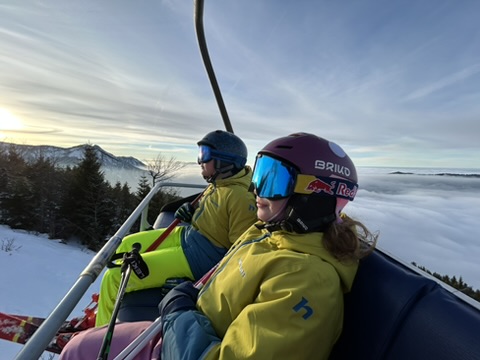
The most common question before winter training is: “Won't he or she be cold?” The second one worth asking right after it is: “Won't he or she be too hot?” A child on skis is not standing at a bus stop. They are moving, sweating, sitting on the chairlift, starting off again, and getting snow in their gloves along the way. Good clothing has to handle this whole cycle.
These are the three goals. Not “as many layers as possible.” Functional layering should wick moisture away from the body, keep you comfortably warm, and protect you from wind and snow on the outside. If a child is wet from sweat, they can cool down very quickly once they stop.
Three layers work better than one huge sweater
American Academy of Pediatrics recommends for winter activities more thinner layers, because they can be adjusted to the conditions and help keep the child dry and warm. Alpine Canada describes the same principle for the youngest skiers: a moisture-wicking base layer, an insulating mid layer, and an outer protective layer.
It sits directly against the body and its job is to wick away moisture. Alpine Canada gives wool or synthetic performance fabric as examples.
Adds insulation. Depending on the temperature, this can be fleece, a performance hoodie, or another suitable insulating layer.
The jacket and pants should protect against wind and snow. In children's skiing, resistance to moisture is also important.
When it warms up or training becomes more intense, we can take a layer off. That is one of the main advantages of layering.
Practical rule: if after the first runs we check the child and their back is noticeably sweaty, they may not need “an even warmer jacket.” Often they need better moisture wicking or one less layer.
A sweaty child is not automatically dressed well
Training creates heat. If clothing doesn't let it escape, the child sweats. The problem comes on the chairlift or during a longer break: a wet layer next to the body suddenly feels very uncomfortable.
That's why we look at the whole day, not just the temperature in the parking lot in the morning.
Slalom, skiing, walking, games, and falls can warm a child up much more than a quiet ride with a parent.
This is where you can see whether the layer insulates and whether the child stayed dry. Wet gloves or a base layer are suddenly a much bigger problem.
Hands: the place where training can end very quickly
Alpine Canada recommends for children waterproof insulated gloves or mittens. From club practice, we add one simple thing: for smaller children, a spare dry pair in the backpack is often more valuable than half of the other things packed “just in case”.
If a child falls, plays in the snow, or takes off their gloves during a break and leaves them on a wet spot, the second pair can save the rest of the training session.
If hands are cold and the gloves are wet, we do not say that “there is only an hour left anyway”. Change them, warm up, check the child. Hand comfort directly affects the ability to focus and the desire to continue.
Feet: the ski boot still has to work like a ski boot
Alpine Canada emphasizes that a properly fitting ski boot is important for developing basic skiing skills. It should hold the foot and lower leg securely, but not be unreasonably tight.
For skiing, we use a functional sock that wicks away moisture. We do not fill the extra space in the ski boot with several thick socks. If the boot does not fit, the solution is the correct size and adjustment of the ski boot, not another layer of fabric.
If you are dealing with the size of skis and boots themselves, see also How to choose skis and ski boots for a child.
Neck, face, helmet, and goggles
A neck warmer is more practical for skiing than a long loose scarf. It should protect the neck and, depending on the weather, part of the face too, without getting in the way of movement or under the helmet.
The helmet must fit properly. Alpine Canada recommends that it sit firmly, straight above the eyebrows, not shift when the head moves, and work together with goggles. Goggles should allow the child to see well while also fitting comfortably with the helmet.
In sunny weather, do not forget protection from UV radiation either. The American Academy of Pediatrics points out that snow reflects radiation and that at higher altitudes sun exposure can be significant.
What we keep in the backpack
For an ordinary children’s training session, we do not need to carry half the household. A few things, though, can solve a problem very quickly:
- spare dry gloves or mittens,
- a spare base layer or T-shirt, if the child sweats a lot,
- dry socks,
- neck warmer, if the first one gets soaked,
- water and a small snack,
- sunscreen and lip balm, depending on conditions.
For all-day skiing, it helps to have dry items within easy reach so you do not have to search for them at the bottom of the car three parking lots away.
We check the child, not just the weather app
Two children in the same jacket can react completely differently. One gets sweaty on every run, the other is cold after ten minutes. That is why, after the first runs, we check it in real life.
We watch mainly:
- whether the base layer is damp from sweat,
- whether the hands and feet are warm,
- whether the gloves or clothing are soaked,
- whether the child is shivering or unusually sluggish,
- whether the child complains of numbness, pain, or a strong chill on exposed skin.
The CDC lists shivering, as well as marked fatigue, confusion, clumsiness, and sleepiness, as warning signs of hypothermia. In frostbite, the first sign may be pain or redness; later, numbness or unusually pale, waxy skin. With such symptoms, we no longer deal with layering for the next run, but with safety and, depending on severity, medical help.
And then one more check after the first runs. The forecast tells us what to prepare. The child tells us — through behavior, temperature, and how damp the clothing is — whether we got it right.