What Is a Wedge Turn
Wedge Turn is a basic change of direction made from a wedge stance: the ski tips are closer together and the tails farther apart. The skier steers the skis into a turn, stays over the support base, and gradually creates more support on the outside ski.
The terminology is not completely uniform across all ski teaching methods. The Swiss method, for example, distinguishes between the first individual direction changes in a wedge and linked wedge turns. It places the first direction change already in the introductory level together with wedge gliding and braking; linked turns are then assessed on an easy blue slope.
How the Turn Works
When skiing straight in a wedge, both skis act in a roughly symmetrical way. If the skier wants to turn, they begin to steer both skis smoothly into the chosen direction and create stronger support on the future outside ski. In a turn to the left, the outside ski is the right ski; in a turn to the right, it is the left ski.
The basic sequence is:
1. the skier stands balanced over the middle of the skis, with ankles, knees, and hips flexed, 2. keeps the skis in a moderately wide wedge, not at maximum opening, 3. guides the skis into the turn with the feet and legs, while the upper body stays calm and naturally oriented in the direction of travel, 4. gradually leans onto the outside ski without suddenly stomping down or tipping the whole body inward, 5. finishes the turn more across the slope, which reduces speed.
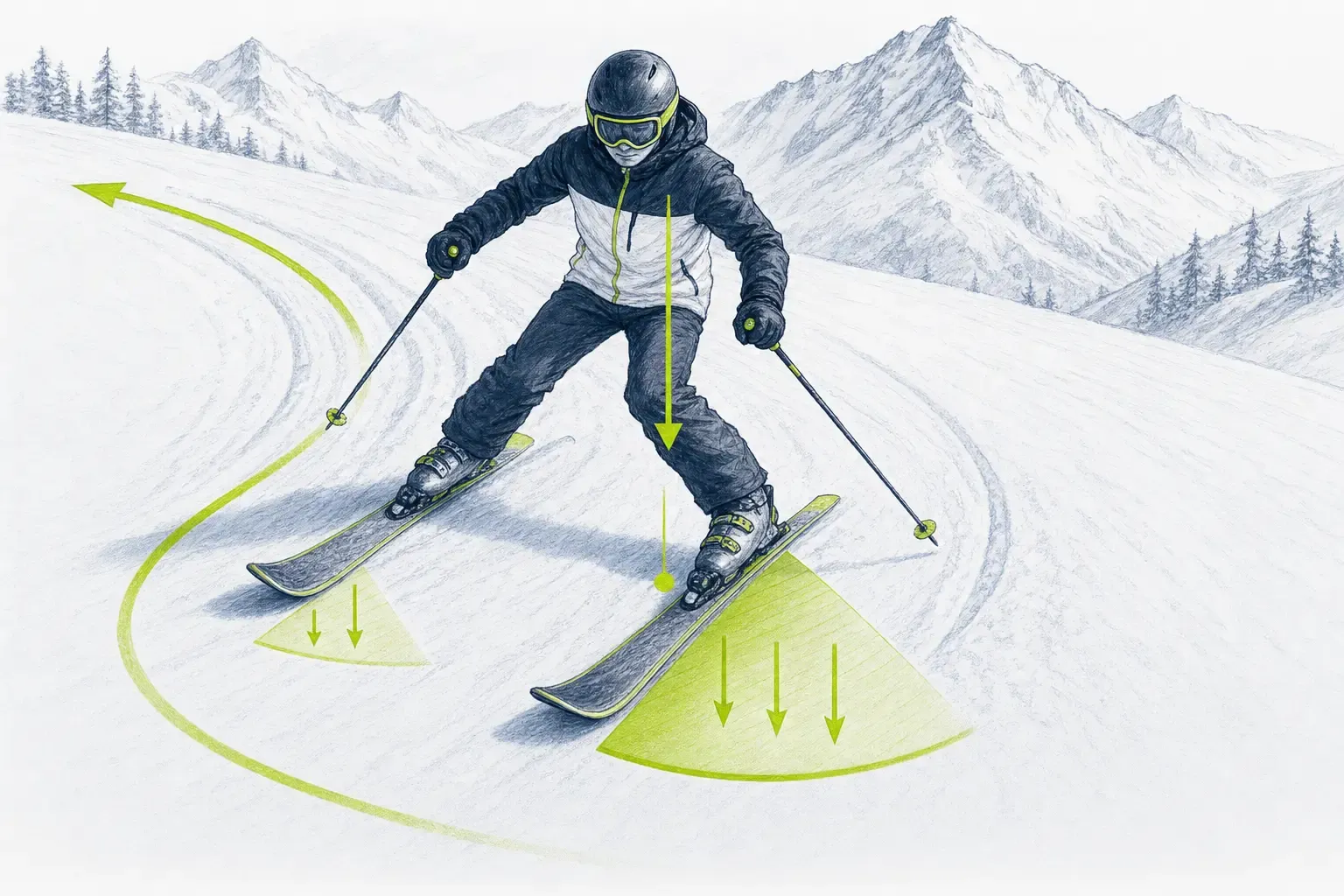
Modern methods emphasize movements common to both wedge and later parallel turns: both skis remain in contact with the snow, the legs guide them into a new direction, and the upper body provides stable support. Speed control comes mainly from the proper shape and completion of the turn, not just from forcefully pushing the skis apart.
Importance in Teaching Children
The wedge turn gives a child the first tool for consciously choosing a direction. Before practicing it, the child should be able to manage the basic stance, starting off, gliding, and safely stopping in a wedge on a very gentle and clear slope. Swiss-Ski includes these skills in the basic phase of children’s skiing, where tasks should be learned in a well-rounded way and suited to the child.
In training practice, age is not the only factor. More important are balance, understanding a simple task, the ability to stop, and suitable conditions. Short runs behind the coach, wide corridors, marks in the snow, and tasks such as going around an object help young children. The goal is not to hold a wedge mechanically, but to combine direction, balance, and speed control.
Typical Mistakes
- Too wide and rigid wedge: the child gets tired quickly and has trouble steering the skis.
- Leaning the upper body inward: reduces support on the outside ski.
- Turning the shoulders instead of the legs: the skis do not respond smoothly and the child loses stability.
- Suddenly stamping down the outside ski: The result is often a jerky movement instead of a smooth arc.
- Long run straight down the fall line: speed builds up and the child then deals with it by braking hard.
- Looking at the tips of the skis: this makes it harder to judge direction and plan the next turn.
- Forcing parallel skis too early: the wedge should narrow gradually as balance and ski control improve.
Coach’s view and racing context
The wedge turn is not a racing technique. But it is a useful step toward understanding the outside ski, the shape of the turn, crossing the fall line, and choosing a line. The coach mainly watches whether the child can change direction to both sides, link turns without speeding up, and adapt them to the available space.
The wedge should therefore not become a dead end or a stance fixed for the long term. With well-mastered fundamentals, it gradually gets smaller, and in later phases of skiing the skis naturally move closer to parallel skiing. Shared movement principles between basic and advanced turns support the smooth development of technique; methods for children’s skiing and later racing skiing build on one another through well-learned fundamental skills.
Sources and further reading
- BASPO and Swiss-Ski: Kids on Ski and Snowboard – methodology and skill levels
- Swiss-Ski: Swiss-Ski Skills for Children – Skiing
- Swiss-Ski: Children's Sports and the Foundation phase
- Swiss-Ski: Teaching materials for alpine skiing and Racing Basics
- PSIA-AASI Rocky Mountain: The Return of the Center Line
- PSIA Rocky Mountain: Alpine Technical Foundations Workbook
- PSIA-AASI Rocky Mountain: Alpine Assessment Guide 2025–26
- Swiss-Ski: J+S course materials with methodological classification of wedge turns