What is a flush
Flush is the common English term for a vertical combination (vertical combination) in slalom. It consists of three or four closed gates set in a straight line one after another. The skier passes through them with quick, alternating changes of direction.
A closed gate is oriented roughly in the direction of the fall line, unlike an open gate, which is set more across the slope. The individual closed gates in a flush therefore create a narrow, rhythmic section that can resemble a corridor.
A flush should not be confused with a hairpin (hairpin). A hairpin consists of two closed gates, while a vertical combination has three or four.
Flush in slalom rules
In the verified edition of the FIS International Competition Rules from July 2025, the term vertical combination is used. A slalom course must include at least one and at most three such combinations, each consisting of three to four gates. The rules also separately define the use of hairpins and offset gate combinations.
From a judging perspective, a flush is not one large gate. Each of its gates is judged separately according to the rules for a correct passage. A competitor therefore cannot skip the inner gate of the combination just because they entered the first gate correctly and exited the last one correctly.
The FIS international rules apply at the relevant FIS competitions. National federations may have their own additions for domestic and youth races, so you must always work with the rules valid for the specific competition and age category.
How to ski a flush
The key is not hitting the poles as hard as possible, but setting the line up correctly. Before entering, the racer needs to recognize the first gate, the rhythm of the combination, and the exit point.
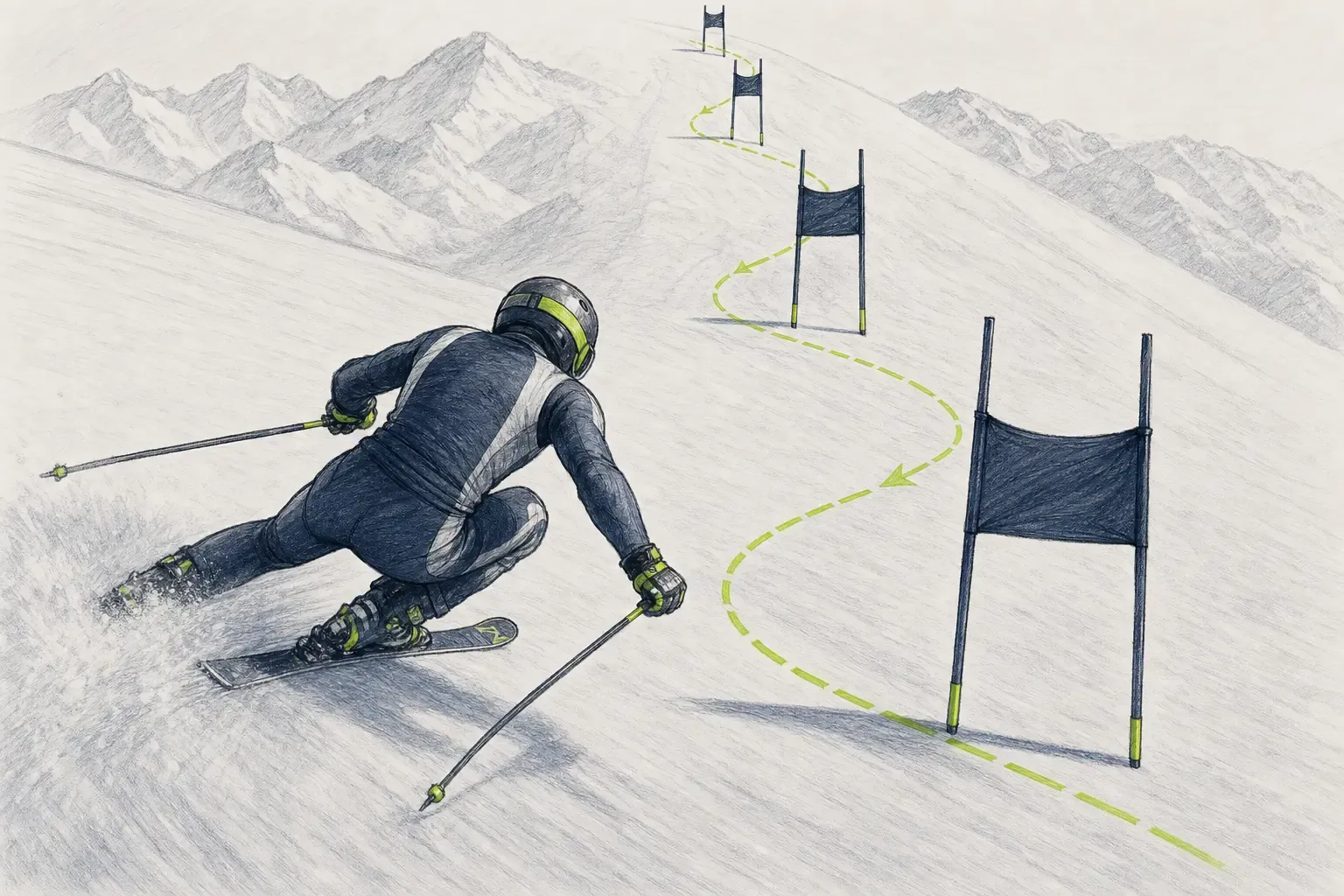
In training practice, the focus is mainly on these elements:
- early line preparation before the first gate,
- balanced stance without excessive leaning back,
- quick, smooth ski transitions,
- a calmer torso oriented mostly down the course,
- active hands in front of the body,
- the gaze guided through the combination to its exit,
- finishing the last turn according to the next gate.
Contact with the pole or blocking it with the hand is not a condition for a correct run. Blocking slalom poles is only a consequence of a more direct race line and belongs in the training of a skier who can already keep balance, direction, and rhythm.
Children's training
With children, flush is taught gradually and in line with their technical level, not just their age. A beginner can first practice rhythmic short turns in a corridor, between markers, or with soft training aids. Later, a short vertical combination can be added, and only then the full setup with long slalom poles.
Speed, slope steepness, spacing, and pole type are chosen by a qualified coach according to the group's abilities, the surface, and safety conditions. The goal of the first exercises should not be hard contact with the poles, but orientation in the combination, regular leg work, and a controlled exit.
Typical mistakes
The most common problem is an unsuitable line before the first gate. A line that is too direct or a late entry gradually pushes the skier out of the optimal track, and the mistake grows at each following gate.
Other mistakes include turning the shoulders after every pole, leaning back, stopping leg work, looking only at the nearest gate, and trying too hard to hit the pole with the hand. It is also wrong to focus only on the inside of the combination without preparing the last turn and the next section of the course.
Coach's view
When there is a mistake in a flush, the coach evaluates the entire section: the approach, body position, rhythm of the transitions, and the exit. A problem at the third gate may only be the result of a poor line before the first. There is no single universal track suitable for every course, because the solution is affected by gate placement, slope, surface, speed, and the skier's abilities. A good run is recognized by balance, maintained rhythm, and a prepared exit, not by how many poles the racer bends.
Sources and further reading
- FIS – International Competition Rules, Book IV: Alpine Skiing, July edition 2025
- U.S. Ski & Snowboard – 2026 Alpine Competition Guide, direct document
- U.S. Ski & Snowboard – 2026 Alpine Competition Guide
- U.S. Ski & Snowboard – Alpine Competition Officials Education Resources
- U.S. Ski & Snowboard – 2025–26 Alpine Precisions
- U.S. Ski & Snowboard – Alpine Course Homologation Rules